Lighting the Spaces In Between: Hallways, Entries and Dining Corners in a Boston Apartment
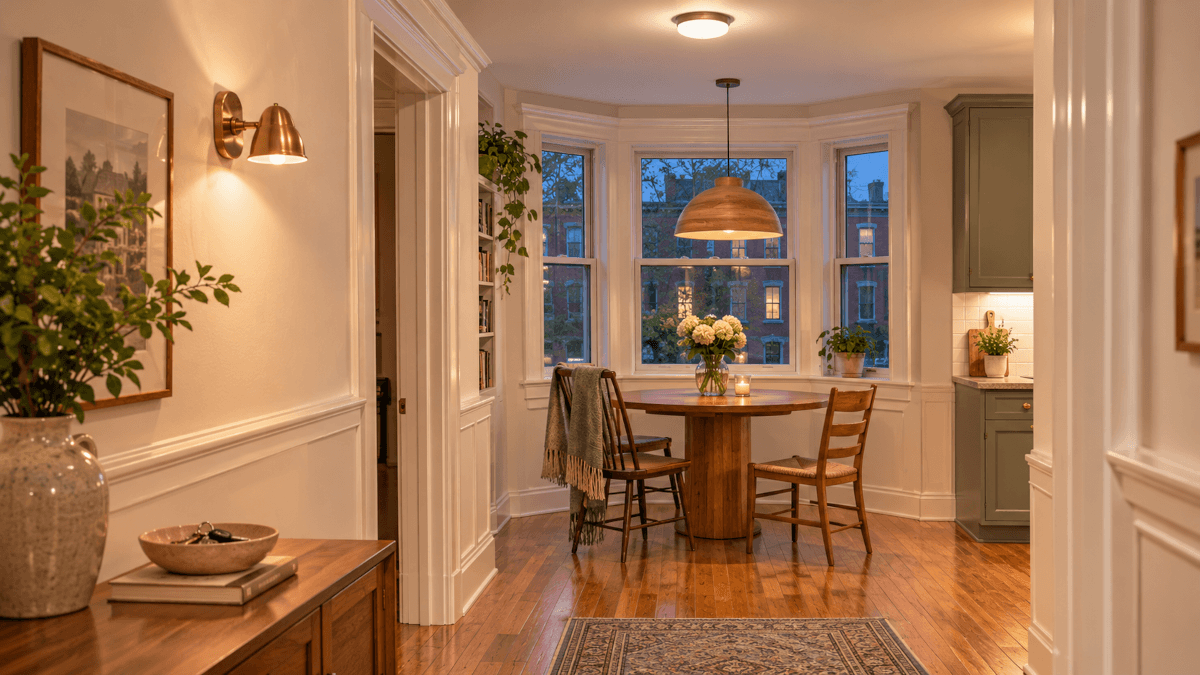
Most apartment lighting advice starts in the living room. But in a lot of Boston apartments, the rooms that feel the most neglected after dark are the ones you walk through rather than sit in: the long hallway of a triple-decker, the narrow entry of a Back Bay walk-up, or the corner of the kitchen where the dining table has been squeezed in.
These spaces usually come with a single ceiling fixture, often a frosted dome that has been there through several tenants. It lights the floor, flattens everything else, and leaves the ends of the hall in shadow. Replacing it with one of the slimmer hallway light fixtures designed for low ceilings and narrow corridors, or simply adding a second source of light further down the hall, can change how the whole apartment feels when you come home on a December evening.
Why the In-Between Spaces Matter More in a Small Apartment
In a large house, a dim hallway is a minor annoyance. In a 700 square foot (about 65 square meters) apartment, it is part of nearly every trip you make. You cross it at night, carry groceries down it, and see it from the sofa. When it stays dark, the apartment reads as smaller and more closed in than it really is.
Boston’s housing stock makes this especially common. Railroad-style layouts in older two-families and triple-deckers put rooms one after another along a single corridor. Converted brownstones often have a long, windowless passage between the front parlor and the rear kitchen. Even newer buildings tend to tuck entries and halls into the interior of the floor plan, far from any window.
The answer is not more brightness for its own sake. It is the same principle that applies to layering light in Boston’s older and more characterful homes: a mix of sources at different heights, each doing a specific job. Hallways and entries simply need that thinking applied on a smaller scale.
Getting the Hallway Right
Start by looking at the hallway the way you actually use it. Where do you need to see clearly? Usually that means the entry point, any turn or doorway along the way, and the far end, where a bedroom or bathroom door sits.
A few practical guidelines help:
- Spread the light out. In a hall longer than about ten feet (roughly three meters), one central fixture rarely covers both ends. Two smaller ceiling lights, or a ceiling light paired with a wall sconce, give more even coverage.
- Mind the ceiling height. Older Boston units can have surprisingly low hall ceilings, especially under stairs or in top-floor units with sloped roofs. Flush or semi-flush fixtures keep clear of heads, while wall sconces work well where the ceiling is too low or too awkward for anything else.
- Think about switches. It is frustrating to walk the length of a dark hallway to reach the only switch. The National Institute on Aging recommends light switches at both ends of a long hall and suggests motion-activated plug-in lights for stairwells and pathways. It is written with fall prevention in mind, but it helps anyone crossing a dark apartment at 2 a.m.
- Use the walls. Light that washes across a wall makes a narrow space feel wider. A sconce or a fixture that throws some light upward and outward does more for a corridor than a fixture aimed straight down.
The entry deserves its own small moment too. It is the first thing you and your guests see, and in many apartments it doubles as a drop zone for keys, mail, and shoes. A modest ceiling light or a sconce beside a mirror makes it feel welcoming rather than like a dark vestibule you hurry through.
The Dining Corner Deserves Its Own Light
In many Boston apartments, there is no separate dining room. The table sits at the edge of the kitchen, in a bay window, or against a living room wall. Without its own light, it borrows from whatever fixture happens to be nearby, which usually means harsh kitchen light or not quite enough of anything.
A pendant over the table fixes this in a way few other changes can. It defines the dining area as its own zone, even when there are no walls around it, and it puts warm light right where people gather. For a table that sits close to the kitchen, a wood pendant light is a particularly good fit, because the natural grain softens a space that is often full of hard surfaces like tile, stone, and stainless steel. Wood also pairs easily with the hardwood floors common in older Boston units.
A few details make the difference between a pendant that looks intentional and one that looks like an afterthought:
- Hang it so the bottom sits roughly 30 to 36 inches (76 to 91 cm) above the tabletop. That keeps the light focused without blocking anyone’s view across the table.
- Choose a size in proportion to the table. A small round table needs a modest shade, while a longer rectangular table might suit a wider pendant or two smaller ones spaced along its length.
- If the table is not centered under an existing ceiling box, a swag hook can move the pendant over the table without new wiring. Many plug-in pendants are designed for exactly this situation.
Bulbs, Color and Control
The bulb inside a fixture shapes the mood as much as the fixture itself.
For hallways, entries, and dining areas, warm white bulbs in the 2700K to 3000K range tend to feel the most comfortable in the evening. Cooler light can make a narrow hall feel clinical, and mixing color temperatures in connected spaces makes the transitions between rooms more noticeable than they need to be.
LED bulbs make it easy to keep more lights on without worrying about the electric bill. According to ENERGY STAR, LED lighting produces light up to 90 percent more efficiently than incandescent bulbs, so adding a second hallway fixture or leaving a low entry light on through the evening costs very little. If your fixtures allow it, dimmable bulbs paired with a compatible dimmer give you bright light when you need it and a gentle glow when you do not.
Renter-Friendly Ways to Do All of This
Not every renter can change fixtures, and many leases require landlord approval for anything hardwired. That does not mean the in-between spaces have to stay dark.
Plug-in wall sconces with cord covers can light a hallway without touching the electrical system. Battery-powered motion lights fit inside closets, along baseboards, or at the end of a hall. A plug-in pendant on a swag hook can define a dining corner and come with you when you move. These kinds of reversible upgrades are among the simplest ways to make a rented apartment feel like home without putting your security deposit at risk.
If you do want to replace an outdated fixture, it is worth asking. Many landlords are open to an upgrade if a licensed electrician handles the installation and you keep the original fixture to reinstall at move-out.
Final Thoughts
The hallway, the entry, and the dining corner rarely get much attention when people think about decorating an apartment. Yet they shape the experience of coming home, moving between rooms, and sharing a meal more than almost any other part of the space.
Spreading light along the length of a hall, giving the entry a small welcoming glow, and anchoring the dining table with a well-chosen pendant are modest changes. In a Boston apartment, where every square foot is working hard, they are often the ones that make the place feel finished.