Boston window replacement: how to stop losing heat in an older building

Brownstones on a snowy Boston street with warm light behind older windows.
Anyone who has spent a February in Boston knows the sound. A low whistle near the window frame, a curtain that moves when nobody’s opened anything, a radiator that runs hard and still loses the argument. In a city where winter does most of the talking, windows are often the weakest part of the building.
They’re also easy to ignore. The glass looks fine, the frame hasn’t rotted, and replacing a dozen units sounds like a project for someone with deeper pockets. But the cost of leaving them alone shows up every month in the heating bill, and tenants feel it just as much as owners do.
This guide is for everyone on both sides of the lease: owners of condos and small multi-families, landlords planning upgrades, and renters who want to know what they’re walking into. We’ll look at why Boston’s building stock is so leaky, what a replacement actually delivers, how to pay for it, and when the work makes the most sense.
Why Boston’s buildings lose so much heat
Picture an owner of a three-decker in Dorchester who runs the numbers after a brutal January. The heat is on, the gas bill is high, and half the third-floor tenants have taped plastic over their windows. After pricing the work, the owner finds that home window replacement financing can spread a full-house job over several years, so the building gets new units this spring instead of waiting until the budget is perfect. Monthly payments that sit near the winter savings make the decision much easier to defend.
That’s not a universal answer. Plenty of owners will pay cash or phase the work floor by floor. The point is that the cost barrier is usually about cash flow, and that can be solved.
The leaks themselves come down to age. The 2022 Boston housing report found that about half of the city’s housing stock was built before 1940, and that 44 percent of the rental stock dates from that period. Those buildings went up with single-pane wood windows, loose weatherstripping, and little insulation by modern standards.
What new windows actually save
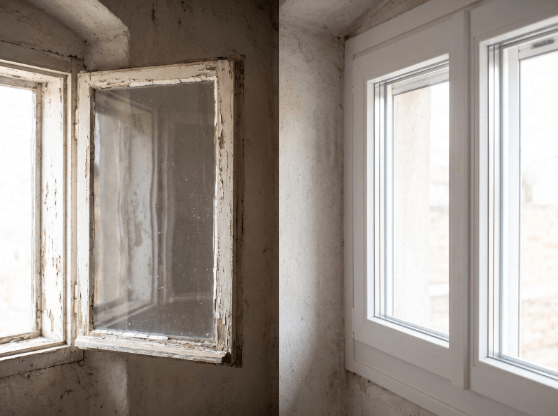
An old single-pane wood sash beside a new double-pane unit in the same wall.
Be skeptical of any promise that new windows will halve your bills. They won’t. ENERGY STAR states that certified windows, doors, and skylights can reduce heating and cooling costs compared with non-certified products, and the best results come from replacing single-pane glass.
For a Boston building that’s a meaningful gain, but it’s not magic. If the attic is bare and the basement rim joists leak air, windows alone won’t carry the load. The smartest sequence is an energy assessment first, air sealing and insulation second, and windows third.
That order also affects incentives. Mass Save lists a per-window rebate when single-pane units are replaced with qualifying ENERGY STAR Most Efficient models, and the program requires a home energy assessment before the job. The rebate won’t cover a full project, but it softens the total, and the assessment often finds cheaper fixes you’d have missed.
Full replacement isn’t the only route. Owners of historic buildings sometimes hit limits, whether from a landmark district’s design rules or from a tight budget, and interior or exterior storm windows can close much of the gap for a fraction of the price. Weatherstripping, window film, and tight-fitting insulated shades help too. Treat these as a stopgap or a phase one, then replace the worst offenders first, usually north-facing units and anything on the top floor where warm air collects and escapes.
What renters should check before signing

A renter feels along a bay window frame for drafts during a walkthrough.
Tenants can’t replace windows, but they can learn a lot in the first week. Open and close every sash. Look for cracked panes, gaps around the frame, and condensation between the layers of glass. Hold a hand near the edges on a windy day, and note any whistle or breeze.
Our move-in day checklist walks through what to document before you unpack, and windows belong on that list. Take photos with dates. If a window sticks, leaks, or won’t lock, you want it on record from day one rather than argued about in March.
It also helps to know your timing. Winter is when drafts are impossible to miss, and it’s also when Boston rents run lower. Winter also tends to bring softer rents and fewer competing applicants. That’s the perfect season to test a unit’s windows in actual cold, then negotiate.
Why turnover is the best time for owners to upgrade

A contractor installs a new window frame in an empty apartment between tenants.
For landlords, the cheapest time to replace windows is when nobody lives there. There’s no furniture to move, no disruption to a tenant’s routine, and no scheduling around work hours. A unit that’s empty for two weeks between leases is a good candidate for a full set of new sashes.
Plan ahead for that window. Tenants usually need to give 30 days’ notice, as our moving out tips point out, which gives an owner a month to order units, book an installer, and line up the next renter. Custom sizes in older buildings can take weeks to arrive, so measure early.
A few practical notes help the job go well. Pick an installer who has worked in pre-war buildings and knows how to handle lead paint rules and irregular openings. Get written quotes that spell out the frame material, glass package, and trim work. And ask whether the proposed units carry the ENERGY STAR label for your climate zone, because the rebate and the savings both depend on it.
Comfort that pays for itself
The case for new windows in an old Boston building rests on three things: lower bills, happier tenants, and a property that’s easier to rent. None of it requires a gut renovation. It requires a clear look at what the building is losing, a sensible order of upgrades, and a payment plan that fits.
Start small if you have to. Test one unit, track the heating bill through a full winter, and compare it with the year before. The data will tell you whether to keep going, and a quiet apartment in February is its own kind of proof.