Trading Boston for Long Beach? A Renter's Safety Checklist With Tips From Coast2Coast First Aid
So you're swapping snow shovels for sunscreen. Moving from Boston to Long Beach is a big change, and most of the to-do list is fun: finding a taco spot, learning the freeway names, figuring out what "June Gloom" means. You'll trade parkas for flip-flops in no time. But before you hang a single picture, it's worth spending an hour on safety in your new apartment. One smart item on that list is learning CPR, and searching for CPR training near Aquarium of the Pacific is an easy way to see what classes are out there before your first weekend in town.
Why start with safety? Because a new place is full of unknowns. You don't know where the exits are yet, how old the alarms are or which hospital is closest. This checklist walks you through it, room by room and step by step.
What Should You Check on Move-In Day?
The first day is busy. Boxes everywhere, a couch stuck in the stairwell. Still, a few checks can't wait until next week.
- Test the smoke alarms. Press the test button on every alarm in the unit. If one stays quiet, tell your landlord or property manager in writing right away. Note the date, too.
- Look for a carbon monoxide alarm. If your building has gas appliances, a fireplace or an attached garage, a working CO alarm is a must. Test it the same way.
- Find every exit. Walk the hallway. Count the doors between your unit and the nearest stairwell, so you could find it in the dark or in smoke. Never plan on using an elevator during a fire.
- Check the locks. Make sure doors and windows close and lock properly. Ask whether the locks were changed after the last tenant moved out.
- Spot the fire extinguisher. Many buildings keep one in the hallway or near the laundry room. Know where it is before you need it.
Where Is Your Nearest Emergency Room and Urgent Care?
Back in Boston, you probably knew exactly where to go if something went wrong. In Long Beach, you're starting from zero.
Take ten minutes now to look up:
- The closest hospital emergency room and the fastest route there
- A nearby urgent care clinic for things that aren't life-threatening, like a sprained ankle or a bad cut that needs a few stitches
- The nearest 24-hour pharmacy
Save all three in your phone's map app. Then drive or walk the route once during the day, so it's familiar if you ever have to go at night.
A quick rule of thumb: call 911 for anything that could be life-threatening, like chest pain, trouble breathing, a person who won't wake up or signs of a stroke. Use urgent care for problems that need attention today but aren't emergencies.
Which Numbers Should You Save in Your Phone?
You'll know 911 already. But a few other numbers make life easier in a new city:
- Your landlord or property manager, plus the after-hours maintenance line
- Your building's front desk or security, if you have one
- The local police non-emergency line for things like noise complaints
- Your gas and electric utility companies, in case of a leak or outage
- The national Poison Help line, so you have it before you ever need it
- A neighbour or nearby friend who can check on your place
Write the most important ones on a card and stick it on the fridge. Phones die. Paper doesn't.
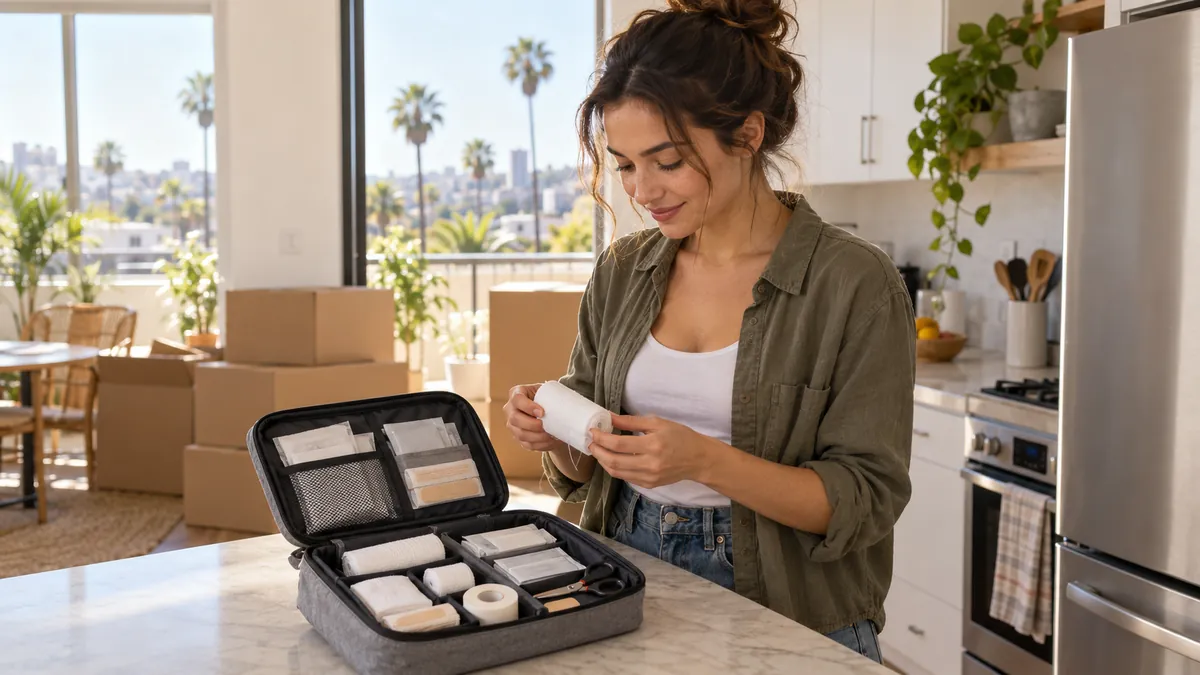
What Goes in a Basic First Aid Kit?
You don't need anything fancy. A simple kit handles most small accidents at home, like a kitchen knife slip or a scrape from a bike ride along the beach path.
Start with these basics:
- Adhesive bandages in a few sizes
- Sterile gauze pads and medical tape
- An elastic bandage for sprains
- Antiseptic wipes
- Tweezers and small scissors
- Disposable gloves
- A cold pack
- Pain relievers you already use
- Any personal medications, plus a written list of them
Keep the kit somewhere easy to reach, like a kitchen cabinet or hall closet. Check it twice a year and replace anything you've used or that has expired.
How Do You Get Ready for Earthquakes in Southern California?
Here's the biggest swap. In Boston, you get ready for nor'easters and blizzards. In Southern California, the thing to plan for is earthquakes.
The good news? Getting ready is mostly common sense, and renters can do almost all of it.
- Secure heavy furniture. Tall bookshelves, dressers and TVs can tip over when the ground shakes. Anchor them to the wall with furniture straps, and ask your landlord first if you need to drill.
- Rethink where things go. Don't hang heavy mirrors or framed art over your bed. Keep heavy items on low shelves.
- Pack a go-bag. Fill a backpack with water, snacks, a flashlight, extra batteries, a phone charger, copies of important papers, a change of clothes, your first aid kit and any medications you need.
- Learn your utility shut-offs. Ask your landlord or building manager where the gas, water and electric shut-offs are, and who is allowed to use them. Knowing this ahead of time saves panic later.
- Practice what to do. If the shaking starts, the common advice is to drop to the ground, take cover under a sturdy table and hold on until it stops.
Why Should Renters Meet the Neighbours?
Boston has a reputation for being a little reserved with strangers. Here's your chance to start fresh.
Knock on a few doors in your first week. Say hi in the elevator. Share your number with one or two neighbours you trust. In an emergency, the people closest to you are often the first ones who can help. They'll also know things you don't, like which parking spot floods when it rains or how the building alarm sounds.
If someone on your floor is older or lives alone, it's kind to check in now and then. That kind of community makes a building feel like home, whether you're three blocks from the beach or a short drive inland.
Why Is Learning CPR the Smartest Thing on This List?
Most people picture cardiac arrest happening in a gym or a busy street. The reality is closer to home. According to the American Heart Association, about 73% of out-of-hospital cardiac arrests happen in homes or residences. That means the person who needs help is most likely a roommate, a partner, a family member or a neighbour down the hall.
The numbers behind it are hard to ignore. The AHA says more than 350,000 cardiac arrests happen outside of hospitals in the US each year. Survival to hospital discharge was only about 9% for EMS-treated cases in 2021. But CPR, if it's performed right away, can double or triple someone's chance of survival.
Here's what CPR training teaches for adults:
- Call 911 and send someone to find an AED
- Push hard and fast in the centre of the chest, at 100 to 120 compressions per minute
- Press at least 2 inches deep and let the chest come all the way back up
- Trained rescuers give 30 compressions, then 2 breaths
- If you're not trained, hands-only CPR is still a big help
A class with a real instructor gives you hands-on practice and feedback, which is what builds the confidence to act. Many providers offer AHA and American Red Cross courses. If you want to compare class options once you've settled in, Coast2Coast First Aid & Safety is one place to start your search.
What Are the Warning Signs You Should Know?
Training also helps you spot trouble early. For a heart attack, watch for chest discomfort or pressure, pain in the arms, neck, jaw or back, shortness of breath, sweating, nausea or light-headedness.
For stroke, remember FAST: Face drooping, Arm weakness, Speech difficulty, Time to call 911.
Your New-Apartment Safety Checklist
Before you settle into that first sunny weekend, run through this quick list:
- Test smoke and CO alarms
- Walk your exit route
- Save your nearest ER, urgent care and pharmacy
- Store key phone numbers, on your phone and on paper
- Stock a basic first aid kit
- Strap down heavy furniture and pack a go-bag
- Learn where your utility shut-offs are
- Meet a neighbour or two
- Sign up for a CPR class
Long Beach is a great place to land. A little planning now means you can enjoy the sunshine, the ocean breeze and the walks along the shore without worrying so much about the what-ifs. Think of it as your welcome-to-California homework.
If you are looking for CPR and first aid training near Pacific Coast Highway and Normandie Avenue, the Harbor City neighbourhood, the Port of Los Angeles, or surrounding areas, you may reach out to Coast2Coast First Aid & Safety in that area.
Frequently Asked Questions
Q: What should I check first when I move into a new apartment?
A: Test every smoke alarm and carbon monoxide alarm, find your exits and make sure the doors and windows lock. Report any alarm that doesn't work to your landlord in writing.
Q: How can renters prepare for earthquakes in Southern California?
A: Strap tall furniture to the wall, keep heavy items on low shelves, pack a go-bag with water, food and supplies, and ask your building manager where the utility shut-offs are.
Q: Where do most cardiac arrests happen?
A: According to the American Heart Association, about 73% of out-of-hospital cardiac arrests happen in homes or residences. That's why learning CPR is so useful for renters and their families.
Q: Does CPR really make a difference?
A: Yes. The American Heart Association says that CPR, if performed immediately, can double or triple a person's chance of surviving cardiac arrest.
Q: What should a basic home first aid kit include?
A: Bandages, gauze, medical tape, an elastic bandage, antiseptic wipes, tweezers, scissors, gloves, a cold pack, pain relievers and any personal medications. Check it twice a year.