Moving to Boston? Here's What to Know About Auto Insurance Before You Register Your Car
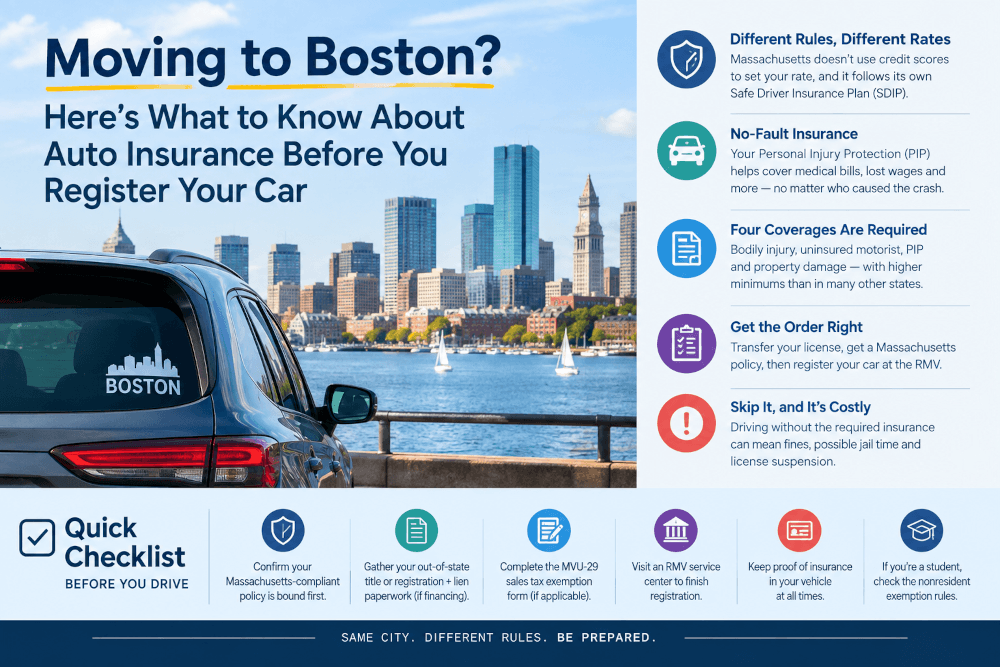
You found the apartment. The lease is signed. The moving truck is booked. And then, somewhere between packing boxes and forwarding your mail, it hits you: your car is still registered in another state, and Massachusetts does things differently.
That surprise is more common than most new residents expect. People relocating to Boston from other states often find that their insurance situation looks nothing like what they left behind, even with a clean driving record and years of on-time payments. The reason isn't random. Massachusetts runs its insurance system on a different set of rules than most of the country, and knowing them before you show up at the Registry of Motor Vehicles (RMV) can save you a wasted trip, or worse, a citation.
Here's what actually matters, in the order you'll run into it.
Why Massachusetts Insurance Can Feel Unfamiliar
Two structural differences explain a lot of the "why is this so different" reaction new residents have.
First, Massachusetts law prohibits insurance companies from using your credit information to set or renew your auto insurance rate. That's not the case in every state, so drivers coming from a place that does weigh credit history may notice their new policy is priced on a different basis entirely.
Second, Massachusetts uses its own merit-rating system, known as the Safe Driver Insurance Plan (SDIP), overseen by the state's Merit Rating Board. It's a point-based system: safe, incident-free years earn credits toward a lower rate, while at-fault accidents and certain violations add points that push rates up. Because SDIP is Massachusetts-specific, a spotless record built up in another state doesn't automatically transfer over at the same pricing tier on day one. It often catches up over time, but it's worth knowing going in rather than being surprised by it.
One more factor worth flagging for anyone still choosing a neighborhood: where you garage your car is a standard rating factor for insurers here, the same as it is elsewhere. If you're still weighing apartments in different parts of the city or its suburbs, it's a reasonable question to ask an agent about once you've narrowed your options, alongside more familiar concerns like commute time and parking availability.
Massachusetts Runs on No-Fault Insurance
Before getting into dollar figures, it helps to understand the framework itself. Massachusetts is a no-fault state for auto insurance, built around Personal Injury Protection (PIP).
PIP pays medical bills, up to 75% of lost wages, and the cost of replacement household services after a crash, regardless of who caused it. Coverage extends to you, household members, authorized drivers and passengers, and even a pedestrian struck by your car. If you're coming from an at-fault state where liability insurance is the whole story, this is the biggest conceptual shift: in Massachusetts, your own PIP coverage is often the first thing that responds after a crash, whether or not you were at fault.
The Four Coverages You're Required to Carry
As of July 1, 2025, Massachusetts requires four types of coverage on every policy, with these minimums:
- Bodily injury to others: $25,000 per person, $50,000 per accident
- Bodily injury caused by an uninsured driver: $25,000 per person, $50,000 per accident
- Personal Injury Protection (PIP): $8,000 per person
- Property damage: $30,000 per accident
That 2025 update raised the bodily injury minimums from the previous $20,000/$40,000, and more than tripled the property damage minimum, which had sat at just $5,000 for years. If you're moving from a state with different minimums, don't assume the numbers translate directly. And keep in mind these are floors, not recommendations. Plenty of drivers carry higher limits than the state minimum, which is worth a conversation with your agent based on your own situation.
Getting the Order Right: License, Then Insurance, Then Registration
One of the most common points of confusion for new residents is a real chicken-and-egg problem: you need Massachusetts insurance to register your car, but it can feel like you need to be registered to get insurance in the first place.
Here's the sequence that actually works. Transfer your driver's license to Massachusetts first. Then get a Massachusetts-compliant policy in place. Your insurer or agent provides proof of coverage, typically an insurance stamp and signature, directly on the Registration and Title Application. Only then do you complete the registration itself at the RMV.
A local, licensed insurance agent can often walk you through this and handle much of the registration paperwork directly, which can save a fair amount of back-and-forth if you're new to the process. According to the RMV's own guidance, there's no grace period once you've become a Massachusetts resident. You're expected to register your vehicle as soon as that happens, not on your own timeline. You'll need your out-of-state title (or your current registration plus lien documentation if you're still financing), and a completed MVU-29 sales tax exemption form, where applicable.
What If Something Happens Before You've Made the Switch?
This is the question that worries a lot of people mid-move, and it deserves an honest answer rather than a confident-sounding guess: whether your existing out-of-state policy would respond to an accident that happens after you've become a Massachusetts resident, but before your paperwork catches up, depends entirely on that policy's own terms. That's a conversation for your insurance agent or carrier. What's certain is that driving without the coverage Massachusetts requires exposes you to the penalties above, regardless of how a fault question eventually sorts itself out.
It's also a good moment to think beyond the state minimums. Uninsured and underinsured motorist coverage exists specifically for the scenario where the other driver has no insurance, not enough of it, or leaves the scene entirely. Hit-and-run accident claims in particular raise their own set of questions: how a claim gets filed when you never got the other driver's information, what your own policy is expected to cover in that gap, and how the timeline for reporting the incident can affect your options. If you ever find yourself dealing with a crash like that, having an attorney involved early can matter, since these cases often turn on evidence and coverage details that are easy to miss without someone who handles them regularly.
Moving for School? A Different Rule May Apply
If you're relocating to Boston as a student rather than a full-time resident, there's a separate, narrower path that may let you keep your car registered in your home state. Under M.G.L. c. 90, § 3, a nonresident student commuting from out of state to a Massachusetts school, or temporarily residing here for school, can keep out-of-state plates if they maintain the required minimum liability coverage, file a Nonresident Student Driver Statement with the local police department where the school is located, and display a school-issued decal.
That's a real, legitimate option, but it comes with real conditions attached. It's not a matter of simply not registering and hoping it doesn't come up. It's also worth weighing against your parking situation: keeping out-of-state plates makes a vehicle ineligible for a resident parking sticker in most Boston neighborhoods, and the cost of paid or off-street parking can add up faster than the insurance savings would.
The Penalties for Skipping This Step
Driving in Massachusetts without the required insurance in place isn't a minor paperwork issue. Under M.G.L. c. 90, § 34J, operating an uninsured vehicle can carry a fine between $500 and $5,000, up to a year in a house of correction, and a license and registration suspension of 60 days for a first offense, or a full year for a repeat offense within six years. On top of that, a separate payment to the state's assigned-risk insurance plan may apply. Massachusetts does carve out a narrower exception for a genuine first-time lapse, capping the fine at $500 with no mandatory jail exposure, but the safest approach is simply not to let a gap happen in the first place.
A Quick Checklist Before You Drive
If you're relocating to Boston with a car, here's the short version to work from:
- Confirm your Massachusetts-compliant policy is bound before you head to the RMV, not after.
- Gather your out-of-state title, or your registration plus lien paperwork if you're financing.
- Complete the MVU-29 sales tax exemption form if it applies to your situation.
- Visit an RMV service center to finish registration once your insurance and license are in place.
- Keep proof of insurance in the vehicle at all times.
- If you're moving for school and considering the nonresident exemption, confirm the current requirements with your school and local police department before you rely on it.
Moving to a new city comes with enough logistics without insurance surprises added on top. Getting the order right and understanding how Massachusetts' rules differ from what you're used to is one less thing to untangle once you've settled in.