Boston's Triple-Decker Path: How Renters Become Owner-Landlords
For generations, Boston's triple-decker has been more than a housing type — it has been a wealth-building vehicle disguised as a house. The idea is old and straightforward: buy a two- or three-unit building, live in one unit, rent the others, and let your tenants help carry the mortgage.
What makes this strategy worth revisiting now is how much the stakes have changed. According to Boston Foundation research cited by the Harvard Crimson, rising Boston home prices have pushed the median to $837,287 — a 40 percent increase between 2015 and 2025 — while the share of renter households able to afford an entry-level home in greater Boston fell from 30 percent to 15 percent over the same period.
At those prices, the traditional single-family purchase looks increasingly out of reach for Boston renters. The owner-occupied multifamily model is one of the few paths where the math can still work — provided the buyer understands what they are getting into before they sign.
Why the Triple-Decker Still Makes Sense in 2026
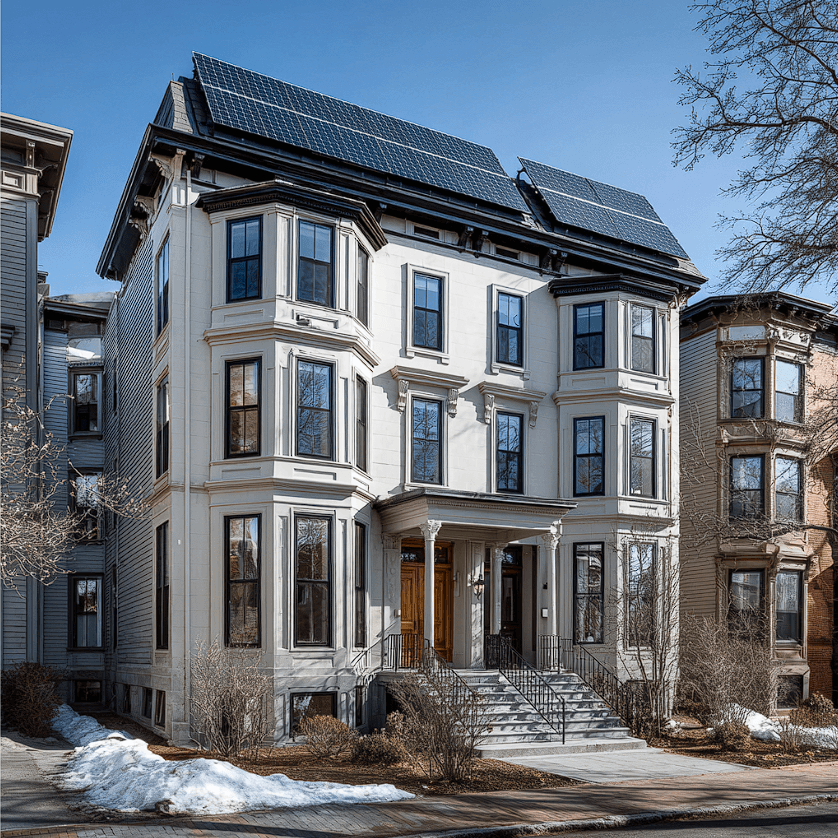
The triple-decker — and its two-unit cousin, the double-decker — became the backbone of Boston's working-class neighborhoods for a reason. According to Boston residential land-use data published by the Boston Planning and Development Agency, three-family dwellings account for roughly 13 percent of the city's total residential land, concentrated especially in Dorchester, East Boston, South Boston, Allston/Brighton, and Roxbury. These buildings were designed with owner-occupants in mind: separate entrances, stacked units, manageable footprints. That architecture translates directly into modern landlord logistics.
The financial case is simple in structure, even if it demands discipline in execution. A buyer who occupies one unit of a three-family building in Dorchester or Jamaica Plain and rents the other two at current market rates can generate enough monthly income to cover a significant portion — sometimes all — of the mortgage payment. That rental offset is not a bonus; it is the mechanism that makes ownership affordable in a market where carrying a single-family home on one income has become genuinely difficult for most buyers.
The strategy also builds equity at a pace a renter cannot match. Every month, the mortgage principal decreases, the property (historically) appreciates, and the landlord gains more ownership of an asset that has been partly financed by other people's rent. For a Boston renter who has been building no equity at all, that compounding effect is significant over a ten- or fifteen-year hold.
Understanding the Financing: FHA Loans and the Owner-Occupancy Requirement
The financing structure that makes this strategy accessible to first-time buyers is the Federal Housing Administration owner-occupied loan. Under FHA guidelines, a buyer can purchase a property of up to four units — a duplex, triplex, or fourplex — using a residential mortgage rather than a commercial loan, as long as they occupy one unit as their primary residence. That occupancy requirement is not optional: buyers must move in within 60 days of closing and maintain the property as their primary residence for a minimum of one year.
The practical significance of that rule is the down payment. FHA owner-occupied loan limits for multifamily properties in high-cost areas like Boston allow buyers to purchase a duplex with as little as 3.5 percent down — and in 2026, the FHA limit for a two-unit property in a high-cost area reaches $1,581,250, with four-unit limits climbing to $2,402,625.
That matters because Boston's multifamily prices have kept pace with the rest of the market. A buyer who tried to finance the same property as a pure investor would face down payment requirements of 15 to 25 percent under conventional guidelines, a difference that can amount to hundreds of thousands of dollars in upfront capital. Owner-occupancy effectively converts a commercial real estate purchase into a residential one, with residential terms.
There is one additional financing advantage worth understanding: lenders can factor projected rental income from the other units into the buyer's qualifying income. That means the same buyer who cannot qualify for a $900,000 single-family home mortgage on their salary alone may qualify for a three-family purchase at a similar price, because the two rented units are generating income that supports the debt. The rules governing how much rental income can be counted vary by lender and loan type, so buyers should confirm specifics with their mortgage broker early in the process. Running a property's expected rents through current FHA multifamily loan terms before making an offer is the only way to know whether the deal pencils on the buyer's actual income, not on optimistic projections.
What Changes When You Become the Landlord
The transition from tenant to landlord is not just a financial shift — it is a legal one. Massachusetts has some of the most tenant-protective landlord-tenant statutes in the country, and owner-occupants who fail to understand those rules before closing can find themselves in compliance problems within weeks of moving in.
Security Deposits
Massachusetts limits security deposits to one month's rent and requires landlords to hold those funds in a separate, interest-bearing escrow account at a Massachusetts bank. Within thirty days of receiving a deposit, the landlord must provide a written receipt that includes the bank's name, address, and account number. Failing to follow these procedures — including the requirement to pay annual interest to the tenant on the deposit — can expose the landlord to liability for triple damages plus attorney's fees. These are not obscure provisions; they are actively enforced, and tenants who rent in Boston often know them.
Habitability Standards and the State Sanitary Code
Owner-occupant landlords are still landlords. Every rental unit in a building must comply with the Massachusetts State Sanitary Code (105 CMR 410), which sets minimum requirements for heat, hot water, pest control, electrical systems, and structural integrity. Heating requirements are specific: between September 16 and June 14, every room must be heated to at least 68°F between 7 a.m. and 11 p.m. Violations can result in inspections, orders to repair, and rent withholding by tenants. Reviewing Massachusetts landlord-tenant law obligations in full before purchasing gives prospective owner-landlords a realistic picture of the legal standard they will be held to from the day they take possession.
Fair Housing in Owner-Occupied Buildings
There is a narrow exemption under federal fair housing law for owner-occupied buildings with two units, which allows the owner to use personal preference in selecting a tenant — but Massachusetts law provides significantly less protection for that exemption than federal law does. Under Massachusetts General Laws Chapter 151B, the fair housing protections covering religion, national origin, sex, age, ancestry, military status, marital status, and disability apply to owner-occupied two-family dwellings, with only the most limited exceptions. Buyers who plan to screen tenants carefully — which they should — need to understand that screening on the basis of any protected characteristic exposes them to civil liability regardless of how small the building is.
Lease and Notice Requirements
Massachusetts distinguishes between tenants with leases and tenants-at-will, and the rules for terminating each type of tenancy differ. A tenant-at-will can be terminated with a minimum of thirty days' written notice, or one full rental period, whichever is longer. A tenant under a fixed-term lease cannot be removed before the lease expires except for cause. New owner-occupant buyers who purchase a building with existing tenants inherit those tenants' lease agreements intact. Before purchasing, a careful review of every existing lease — including the remaining term, the rent, and any side agreements — is essential due diligence.
Selecting the Right Neighborhood and Property
Not every Boston neighborhood produces the same rental income relative to purchase price. The neighborhoods with the heaviest concentrations of two- and three-family housing — Dorchester, Mattapan, East Boston, Hyde Park, and Roslindale — tend to offer better capitalization rates than the premium neighborhoods closer to downtown. A buyer primarily motivated by owner-occupancy, however, is making a different calculation than a pure investor: they need a neighborhood where they want to live, not just one where the numbers pencil out on a spreadsheet.
The building itself matters as much as the location. Triple-deckers and double-deckers in Boston are often wood-frame construction from the early twentieth century, which means mechanical systems, electrical panels, and roof conditions deserve careful attention during the inspection process. A building with a deferred-maintenance furnace or a sixty-amp electrical panel will require capital expenditure before it can legally meet the State Sanitary Code's habitability standards. That cost needs to be factored into the purchase price or the post-close budget, not discovered after closing.
Prospective buyers should also evaluate the existing tenancy situation before making an offer. A building with two long-term, month-to-month tenants paying below-market rent presents a different set of risks and opportunities than a vacant building or one with leases expiring in sixty days. Each scenario has implications for short-term cash flow, the timeline to stabilize rental income, and the legal process required if a unit needs to be vacated.
Tax Implications of the Owner-Occupant Landlord
Owning an income-producing property changes a buyer's tax situation materially. The rented units are treated as rental property for federal income tax purposes, which means the landlord can deduct operating expenses — mortgage interest on the rental portion, property taxes, insurance, repairs, and depreciation — against rental income.
The owner-occupied portion of the building is treated as a primary residence, which means mortgage interest and property taxes on that unit remain deductible on Schedule A for buyers who itemize. Allocating expenses between the owner-occupied unit and the rental units requires clear record-keeping and, for most buyers, the help of a CPA who understands rental real estate. The tax treatment on sale is also more complex than a straight residential sale: depreciation taken during ownership is subject to recapture at the federal level, which affects the net proceeds calculation when the property is eventually sold.
The Work Involved: Landlording Is Not Passive
The appeal of the owner-occupant model is real. The risks are also real, and they deserve honest consideration. Being a live-in landlord means sharing a structure with tenants whose maintenance requests, lease violations, and personal situations become the landlord's problem to manage — often without the buffer of a property management company. A furnace that fails at 2 a.m. in January is the landlord's emergency to handle, not someone else's.
Vacancy is a cost that first-time landlords frequently underestimate. A triple-decker in Boston with two rental units and one vacancy loses a significant portion of its rental income immediately. The landlord's mortgage does not pause during the vacancy, which means the owner must be financially prepared to carry the full payment for a period, or to move quickly on re-renting. Having three to six months of reserves beyond the down payment is not a luxury for owner-occupant landlords; it is a practical requirement.
Buying With Eyes Open
The owner-occupant model only works for buyers willing to do the work in advance. The financing structure rewards careful preparation: understanding FHA occupancy rules, calculating projected rental income with a lender who has multifamily experience, and confirming that the property's mechanical systems can actually meet code on day one. Buyers who show up to closing without that groundwork typically discover the gaps through expensive surprises.
The legal landscape demands the same kind of preparation. Massachusetts security deposit law, the State Sanitary Code, fair housing rules, and lease termination procedures are not topics a new landlord can pick up casually after closing. Reading them in advance — and ideally consulting an attorney who handles small landlord matters — is the difference between a building that produces income and one that produces problems.
What makes the triple-decker worth all of that effort is what it does over time. A building bought today in Dorchester or East Boston with the right financing, the right tenants, and a careful operational plan compounds in two ways at once: equity through principal paydown, and historically, appreciation in one of the country's most constrained housing markets. Neither is guaranteed in any given year. But for buyers navigating Boston's competitive homebuying landscape, the owner-occupant path remains one of the few realistic ways to convert rent into ownership.