Why Your Home Feels Uncomfortable Even When the Thermostat Is Set Correctly
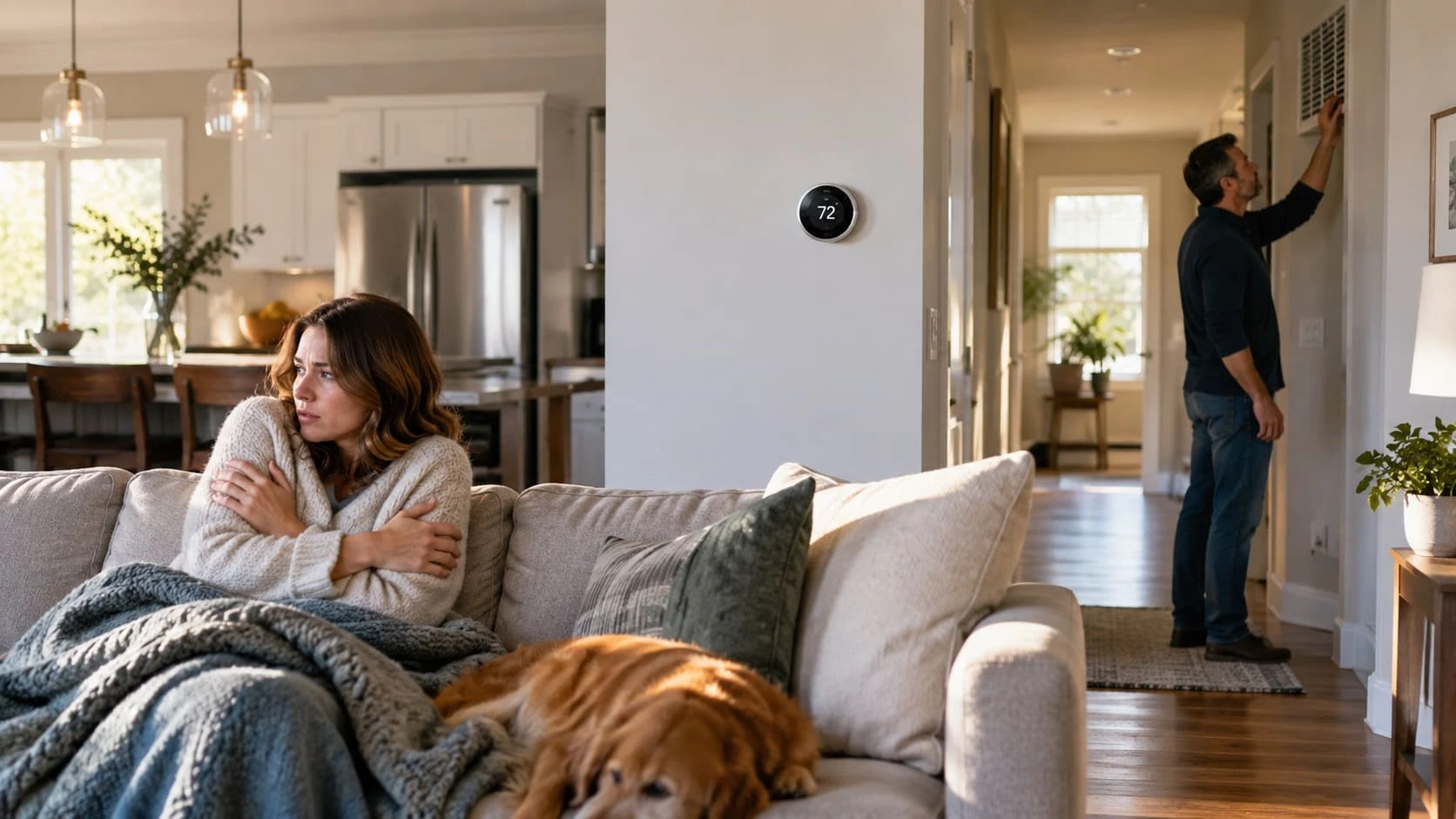
A thermostat can show the expected temperature while a home still feels too warm, too cool, humid, drafty, or uneven from room to room. That happens because thermal comfort depends on more than air temperature alone. Radiant temperature, humidity, air movement, clothing, activity, and surrounding surfaces can all affect how comfortable a person feels.
Inside a home, solar exposure, airflow, insulation, air leakage, thermostat location, duct performance, and HVAC operation can therefore create noticeable comfort differences even when the thermostat appears to be working normally.
Why Thermostat Temperature and Thermal Comfort Are Different
A thermostat measures temperature at one location. It does not directly measure conditions in every room.
A reading of 72°F, for example, may accurately describe the air around the thermostat while a west-facing bedroom is absorbing afternoon sun or an upstairs room is receiving less conditioned airflow.
Surface temperatures matter too. Warm windows, ceilings, and exterior walls can make a room feel hotter even when the air temperature is close to the thermostat setting. In winter, cold glass and exterior surfaces can make the same air temperature feel cooler.
That is why the thermostat number should be treated as one piece of information rather than a complete measurement of comfort throughout the house.
Common Reasons a Home Can Feel Uncomfortable
Several HVAC and building conditions can produce similar symptoms.
| What You Notice | Possible HVAC Factor | Possible Building or Room Factor |
|---|---|---|
| One room feels warmer | Low supply airflow, duct restriction | Solar gain, windows, insulation |
| Several rooms feel stuffy | Poor air distribution | Closed doors, limited circulation |
| Home feels humid | Cooling or runtime issue | Outdoor moisture, air leakage, indoor moisture |
| Thermostat looks normal but room feels hot | Sensor location, airflow imbalance | Radiant heat, strong sun exposure |
| System runs longer than usual | Reduced airflow or heat-transfer performance | Weather, insulation, open windows |
| Temperature changes quickly | Cycling or control issue | Air leakage, strong solar exposure |
| Some rooms feel drafty | Air distribution imbalance | Window or door leakage |
These are not diagnoses. They are clues that help narrow the range of possible causes.
Thermostat Location Can Distort the Picture
Where the thermostat is installed can strongly affect what it reports.
A thermostat mounted on a shaded interior wall may reach its setpoint while rooms with large windows or greater exterior exposure remain uncomfortable.
Its reading can also be influenced by nearby conditions such as:
- direct sunlight;
- lamps or electronics;
- exterior doors;
- supply vents;
- kitchens;
- drafts;
- poorly insulated walls.
This means the thermostat can be operating correctly while still providing an incomplete picture of conditions elsewhere in the home.
If only one or two rooms are uncomfortable, compare those spaces with the thermostat location before assuming the entire HVAC system is failing.
Solar Gain Can Make a Room Feel Much Warmer
Rooms with large windows or strong afternoon exposure can gain substantial heat from sunlight.
A west-facing bedroom, living room, or home office may become uncomfortable late in the day even while the thermostat in another part of the house remains near its target temperature.
The amount of heat entering the room depends on factors such as:
- window orientation;
- glass area;
- glazing type;
- exterior shading;
- blinds or curtains;
- nearby trees or structures.
A useful clue is timing. If a room becomes noticeably warmer as direct sunlight reaches it and improves after sunset, solar gain may be contributing significantly to the problem.
Simply lowering the thermostat may overcool other parts of the house without addressing the underlying imbalance.
Radiant Heat Can Change How a Room Feels
Air temperature is only one part of thermal comfort.
People also exchange heat with nearby surfaces. A room with warm windows, ceilings, or exterior walls may feel hotter than another room with the same measured air temperature.
During winter, the reverse can happen. Cold windows and walls can make occupants feel chilled even when the thermostat shows a normal indoor temperature.
This is particularly relevant in rooms with:
- large glass areas;
- older windows;
- strong sun exposure;
- limited insulation;
- large exterior wall surfaces.
When two rooms have similar air temperatures but feel very different, radiant conditions may help explain why.
Humidity Has a Major Effect on Comfort
Humidity changes how temperature feels.
During cooling season, higher indoor humidity can make a room feel warmer and less comfortable because moisture evaporates from the skin less effectively. During heating season, very dry air can also affect comfort.
Indoor humidity can be influenced by:
- outdoor weather;
- showers and cooking;
- ventilation;
- plumbing moisture;
- occupancy;
- air leakage;
- HVAC operation.
Air-conditioning systems normally remove some moisture while cooling, but high indoor humidity does not automatically mean the AC system is defective.
It becomes more significant when it appears with other changes, such as poorer cooling, longer operating cycles, or difficulty maintaining normal indoor conditions.
Airflow Can Create Room-to-Room Differences
An HVAC system may be producing properly heated or cooled air but distributing it unevenly.
Supply airflow can be affected by:
- dirty filters;
- partially closed registers;
- blocked vents;
- duct leakage;
- duct restrictions;
- blower performance;
- coil conditions;
- pressure imbalances.
Furniture, curtains, rugs, and stored items can also interfere with airflow near registers.
If one vent has become noticeably weaker while others remain normal, the issue may be localized. Reduced airflow across several rooms points toward a broader distribution or equipment-related cause.
Comparing current airflow with how the system normally behaves is more useful than judging vent strength in isolation.
Return Air Is Part of the Airflow System
Conditioned air entering a room also needs a path back toward the HVAC system.
Poor return-air movement can contribute to pressure differences and uneven temperatures, especially in bedrooms or other spaces that remain closed for long periods.
Depending on the home, return air may move through:
- dedicated return grilles;
- hallways;
- door undercuts;
- transfer grilles;
- other designed return pathways.
If a bedroom becomes noticeably warmer, cooler, or stuffier when the door is closed, return-air movement and pressure balance deserve consideration.
Furniture, boxes, or other objects placed in front of return grilles can also interfere with normal circulation.
Duct Problems Can Affect Both Temperature and Airflow
Ductwork can influence how much conditioned air reaches each room and what temperature that air has when it arrives.
Potential problems include:
- disconnected duct sections;
- leaking joints;
- crushed flexible ducts;
- damaged ducts;
- restricted sections;
- inadequate duct insulation in unconditioned spaces.
Because ducts are often hidden above ceilings, behind walls, or in attics and crawl spaces, a problem may not be visually obvious from the room itself.
Persistent temperature differences combined with weaker airflow can provide a reason to investigate the distribution system further.
Insulation and Air Leakage Can Mimic HVAC Problems
Not every comfort problem starts with heating or cooling equipment.
Heat can enter or leave a home through:
- gaps around windows and doors;
- attic bypasses;
- worn weatherstripping;
- insufficient insulation;
- poorly sealed penetrations;
- other unintended openings.
During hot weather, these weaknesses can increase heat gain. During colder periods, they can increase heat loss.
The resulting symptoms can resemble HVAC problems:
- rooms that are difficult to condition;
- drafts;
- longer system operation;
- uneven temperatures;
- increased energy consumption.
That distinction matters because changing HVAC settings or equipment does not correct a building-envelope problem.
Runtime and Cycling Patterns Can Add Useful Context
HVAC runtime changes naturally with outdoor conditions.
A system may run much longer during very hot or cold weather simply because the building has a greater heating or cooling load. Longer operation alone is therefore not proof of equipment failure.
The pattern becomes more informative when conditions that used to produce normal comfort now result in:
- longer operating periods;
- weaker airflow;
- rising humidity;
- difficulty reaching the setpoint;
- uneven room temperatures.
The opposite pattern can matter too.
If equipment begins starting and stopping much more frequently than usual, possible contributors include thermostat conditions, airflow restrictions, control issues, equipment characteristics, or system sizing.
The key observation is whether the cycling pattern has changed and whether comfort changed at the same time.
Sometimes the Thermostat Reading Should Be Checked
If indoor conditions consistently seem different from what the thermostat displays, comparing its reading with a separate indoor thermometer can provide additional context.
This should not be treated as a precision calibration test. Consumer thermometers vary, and temperature changes naturally across a room.
However, a large and repeatable difference may indicate that thermostat location, sensor behavior, or nearby environmental conditions should be examined.
It is also worth confirming simple settings:
- heating or cooling mode;
- programmed schedules;
- temperature setpoint;
- fan mode;
- battery status, where applicable;
- recent configuration changes.
Sometimes an apparent HVAC problem begins with a setting that changed unintentionally.
Energy Use Can Support the Diagnosis
A single high utility bill does not prove that an HVAC system has become inefficient.
Energy consumption is affected by weather, utility rates, occupancy, thermostat settings, appliances, and household routines.
Energy data becomes more useful when it matches a broader pattern. For example, if similar weather conditions are accompanied by longer HVAC runtime, declining comfort, and higher consumption, there is stronger reason to investigate what has changed.
The bill is supporting evidence, not a diagnosis by itself.
New Sounds, Moisture, or Odors Can Provide Additional Clues
Comfort changes sometimes appear together with other symptoms.
A new rattling, buzzing, scraping, clicking, or vibration can provide useful context, particularly if it occurs consistently during startup, shutdown, blower operation, or another specific part of the HVAC cycle.
Water near indoor cooling equipment may point toward a condensate drainage issue, but nearby plumbing, roof leaks, water heaters, or condensation on other cold surfaces can produce similar evidence.
Odors also require context. Dust, cooking, drains, household products, indoor moisture, and outdoor air can all create smells that appear to come from the HVAC system because the system circulates air through the home.
A burning or electrical smell should be handled differently. If HVAC equipment produces a persistent burning or electrical odor, smoke, sparking, unusual overheating, or repeated breaker trips, stop operating the affected equipment and have the source evaluated.
Look for Patterns Rather Than Isolated Symptoms
The same comfort complaint can have several possible causes.
A few combinations are particularly useful:
- One room is warmer and airflow is weaker: investigate both air distribution and room-specific heat gain.
- The home feels humid and cooling cycles are longer: consider moisture conditions together with HVAC performance.
- A room becomes uncomfortable only during afternoon sun: solar gain may be a major factor.
- A bedroom becomes stuffy when the door is closed: return-air movement may be restricted.
- The thermostat reads normally but exterior rooms remain uncomfortable: consider airflow, radiant heat, windows, insulation, and air leakage.
Because HVAC and building problems can produce overlapping symptoms, HVAC troubleshooting guides can help homeowners compare airflow, thermostat, drainage, comfort, and equipment clues before deciding what information is worth documenting.
What Homeowners Can Check Without Diagnosing Equipment
A few basic observations can make troubleshooting much more focused:
- Identify which rooms are affected.
- Note the time of day the problem appears.
- Check whether direct sunlight corresponds with the discomfort.
- Confirm that supply and return vents are not blocked.
- Check thermostat mode, schedule, and setpoint.
- Note when the HVAC filter was last inspected or replaced.
- Compare airflow with normal system operation.
- Observe whether closing doors changes room comfort.
- Note unusual humidity, moisture, sounds, or odors.
- Record whether the problem occurs during heating, cooling, or both.
This creates a clearer picture of the conditions surrounding the problem without assuming a particular component has failed.
Think of the Home as a Complete Comfort System
Indoor comfort results from the interaction between HVAC equipment and the building around it.
The thermostat measures conditions at one location, while every room has its own combination of airflow, windows, solar exposure, surface temperatures, insulation, air leakage, and occupancy.
That is why changing the thermostat setting does not always solve an uncomfortable room.
When the thermostat looks normal but the home does not feel right, focus on where the discomfort occurs, when it appears, what environmental conditions affect it, and whether airflow or equipment behavior has changed.
Those patterns provide a much stronger starting point for understanding the problem than the thermostat number alone.