A Renter's Guide to Narrow Stairs, September 1st, and Sofas That Actually Fit
The hardest part of furnishing a Boston apartment is usually not choosing the furniture. It is getting the furniture through the front door and up three flights of a triple-decker that was framed out around 1910, when nobody was planning for a 40-inch-deep sectional.
Renters here run into this constantly. You find the couch, you measure the living room, it fits with room to spare, and then it gets stuck on the half-landing of a staircase that turns a hard 90 degrees against a plaster wall you are financially responsible for. In a city where most of the housing stock predates the elevator and most of the leases turn over on the same weekend, the logistics of the move deserve as much thought as the shopping.
Here is how to think it through, from someone who has watched a lot of good furniture die on Boston stairs.
Why Boston is uniquely hard on furniture
A few things about this city stack the deck against a big, rigid piece of furniture.
The building stock is old. Triple-deckers, converted Victorians, and brownstones in Back Bay and Beacon Hill were built with narrow, winding staircases, tight landings, and low headroom over the stairs. Many have a switchback with a mid-floor landing, and that landing is where sofas and mattresses go to get wedged.
Walk-ups are everywhere. Outside the newer luxury towers in the Seaport or downtown, a huge share of Boston rentals have no elevator. A fourth-floor walk-up is a normal listing in Allston, Mission Hill, and parts of South Boston. Whatever you buy, you or someone you pay is carrying it up by hand.
The doors and hallways were sized for another era. Interior door openings in older units often run somewhere around 28 to 32 inches clear, and some period front doors are narrower still. That is the number that traps people, because a sofa almost always goes through a doorway on its side, depth-first.
Then there is the calendar. A large majority of Boston leases start on or around September 1. For a few days the streets fill with rental trucks, the curbs fill with the discarded furniture that locals affectionately call Allston Christmas, and every mover in the metro area is booked solid. If you are moving during that window, everything is slower and more expensive, so your margin for a furniture mistake shrinks to nothing.
One more piece of local knowledge that saves people every year: Storrow Drive and Memorial Drive have low stone overpasses that box trucks cannot clear. Trucks that try it anyway get "Storrowed," which is the Boston verb for peeling the roof off your rental van on an underpass. If you rent a truck, know its height and route it around those roads.
Measure the path, not just the room
Almost everyone measures the room. Very few people measure the route the furniture actually has to travel to get there, and that route is what decides whether the piece makes it.
Before you buy anything large, measure these:
- The front door clear opening, both width and height, with the door open and any weatherstripping accounted for.
- The narrowest point of the hallway leading in.
- Every stair turn, plus the size of each landing where the piece has to pivot.
- The ceiling height above the staircase, since low headroom kills the angle you need to tilt a sofa.
- The gap between the banister and the wall.
- Any interior doorway the piece has to clear once it is inside.
For reference, a standard three-seat sofa is roughly 84 inches long, about 38 inches deep, and about 34 inches tall. The measurement that gets people stuck is depth against door width, because the sofa turns on its side to go through.
There is a trick worth knowing here. Measure the sofa's diagonal depth, from the top back corner down to the bottom front corner, rather than just its flat depth. That diagonal is the real number when you pivot a sofa through a doorway. If the diagonal depth is less than the height of the door opening, the piece can usually be hooked and rotated through. If it is not, no amount of pushing is going to help.
Stairwells follow the same logic. A single straight run is forgiving. A switchback with a small mid-floor landing is where a long, rigid sectional simply runs out of room to turn. Measure that landing carefully and picture the piece rotating inside it. When you are unsure, put painter's tape on the floor in the shape of the sofa's footprint and walk it through the turns before you order.
Your delivery options, ranked by how much the stairs will hurt
Not all delivery is the same, and the cheap option can cost you a deposit.
White-glove delivery means the crew carries the item up, places it where you want it, and takes the packaging away. It costs more, and in a walk-up it is often worth every dollar. One thing to confirm in writing: that they will actually go above the first floor. Some carriers cap at the lobby or the first flight and leave the rest to you.
Threshold or curbside delivery drops the item at your door or on the sidewalk. It is inexpensive, and it is fine for anything boxed and manageable. For a fully assembled sofa headed to a third-floor unit, it means you are now the moving crew.
Hoisting is the Boston and New York classic. When a piece cannot make the stairs, movers sometimes pull a window sash and lift the furniture up the outside of the building on straps. It works, it is not cheap, and it is a genuine last resort. You see it in the North End and on Beacon Hill, where the staircases were never going to cooperate.
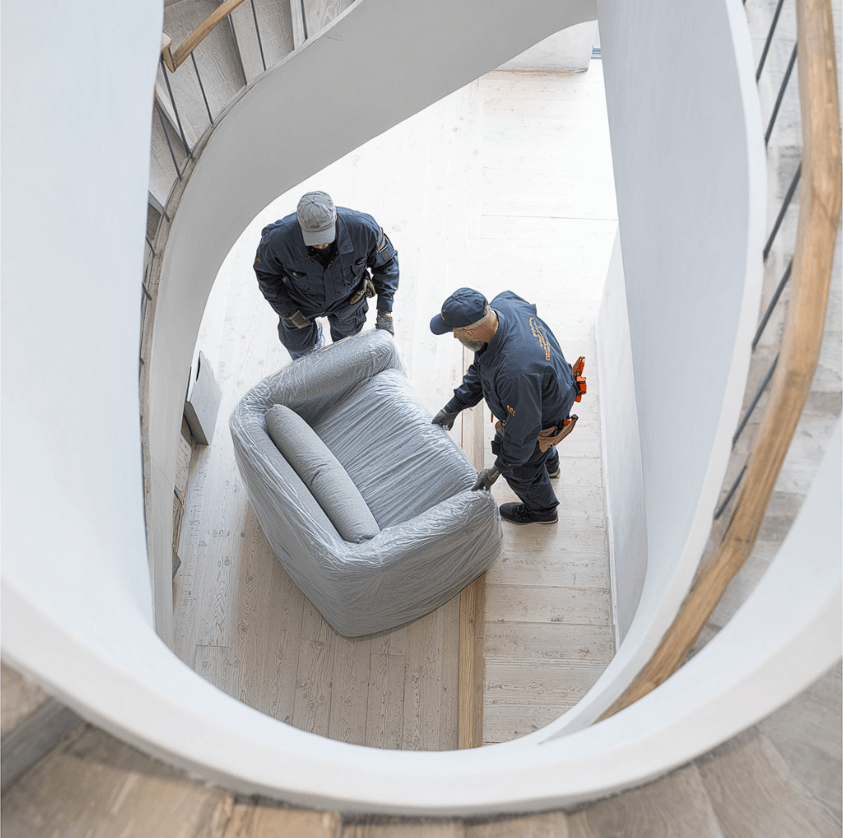
DIY with friends is the budget route, and plenty of people pull it off. Just be honest about the risk. A rigid 84-inch sofa meeting a 180-degree stair turn is one of the most common ways renters gouge century-old plaster and lose part of a security deposit.
The furniture that is built for this problem
Because so many renters hit this exact wall, the furniture market has quietly reorganized itself around it. If your building fights you on the stairs, buy for the building.
Flat-pack furniture from IKEA and similar sellers ships in flat boxes and assembles in the unit. It solves the staircase completely and costs you an afternoon and some patience with the hardware.
Knock-down and modular sofas arrive in separate sections that connect without tools. Because no single piece is the full length of the couch, each part clears a normal doorway and turn on its own.
Compressed, boxed sofas are the newer answer. The sofa is vacuum-compressed at the factory and packed into a box you can carry up the stairs yourself, and it expands into its full shape once you open it. There is no frame to wrestle around a landing and nothing to assemble. This is the niche where a growing number of brands now sell frame-free foam sofas that ship compressed in a box, and the appeal for a walk-up is simple: the box is what goes up the stairs, not the finished couch, so one or two people can get it to a third-floor apartment without removing a door or renting a hoist.
Secondhand with disassembly is a Boston rite of passage, whether from Facebook Marketplace or straight off an Allston curb on September 1. If you go this way, check whether the legs and cushions come off so the frame can make the turns, and inspect anything upholstered for pests before it crosses your threshold.
Every one of these involves a tradeoff, and it is worth being clear-eyed about them. Flat-pack costs you assembly time. A boxed foam sofa gives you a firmer, more casual sit than a traditional sprung frame. Secondhand carries condition and pest risk. None of them is automatically right. The point is to match the piece to the staircase you actually have.
Timing it around September 1
If your lease starts in the September crush, order early. Delivery windows tighten through August, movers book out weeks ahead, and freight slows down across the board. Something you could get in three days in April might take two weeks at the end of the summer.
For anything shipped, check the lead time and aim to have the furniture arrive a few days after your move-in date rather than before it. A sofa box sitting in a shared hallway for a week is a hazard and a good way to start off badly with the neighbors who share your one staircase.
On that note, keep boxes and packing flat and clear of the stairwell while you unpack. In a triple-decker, that staircase is the only way out in a fire, and blocking it is both dangerous and the kind of thing that gets a quick complaint to the landlord.
A quick pre-move checklist
Run through this before you buy anything large:
- Measure the door opening, the narrowest hallway, every stair turn, and each landing pivot.
- Measure the furniture's diagonal depth, not just its flat depth.
- Confirm exactly what your delivery includes, especially which floor they will carry to.
- If you are renting a truck, know its height and route it clear of Storrow and Memorial Drive.
- Pull a moving-truck or street-occupancy permit from the city if you need to hold curb space, which matters most downtown and in the older, narrower neighborhoods.
- If your building has no elevator, lean toward pieces that ship in a box.
The renters who have the smoothest September are the ones who solved the staircase before they fell for a specific sofa. Measure the path first, buy for the building you actually live in, and moving day stops being a story you tell later with a wince.