Apartment-Hunting Lessons From Families Who School at Home
The showing is at 5:30 on a Thursday, because that is when showings happen. The agent flips on lights, opens the closet with the water heater in it, mentions the walk to the Green Line. One renter hangs back in the dining room, running a tape measure along the longest wall. If her family signs, that wall becomes a school. Class starts at nine.
She has company. Home education is now a measurable slice of city life. Federal household surveys after 2020 recorded homeschooling at roughly double its earlier share, and urban families are a real part of the growth. These are not cabins in the woods. They are households in triple-deckers and mid-rises, running on lesson plans, attendance logs, and work samples, because in most states that is what the law asks. Massachusetts, like every state, sets its own requirements for families who school at home, and the specifics vary; that part is the family's to manage, not the landlord's.
What happens at those dining tables is real school, with real records behind it. Many families run it through an enrolled program such as Numa School, an accredited homeschool program, which keeps the curriculum and the paperwork in order wherever the household lives. The one thing no program can supply is the apartment. That still has to be found the hard way, and the checklist these families use is specific, mostly free to evaluate, and worth borrowing by any renter with kids.
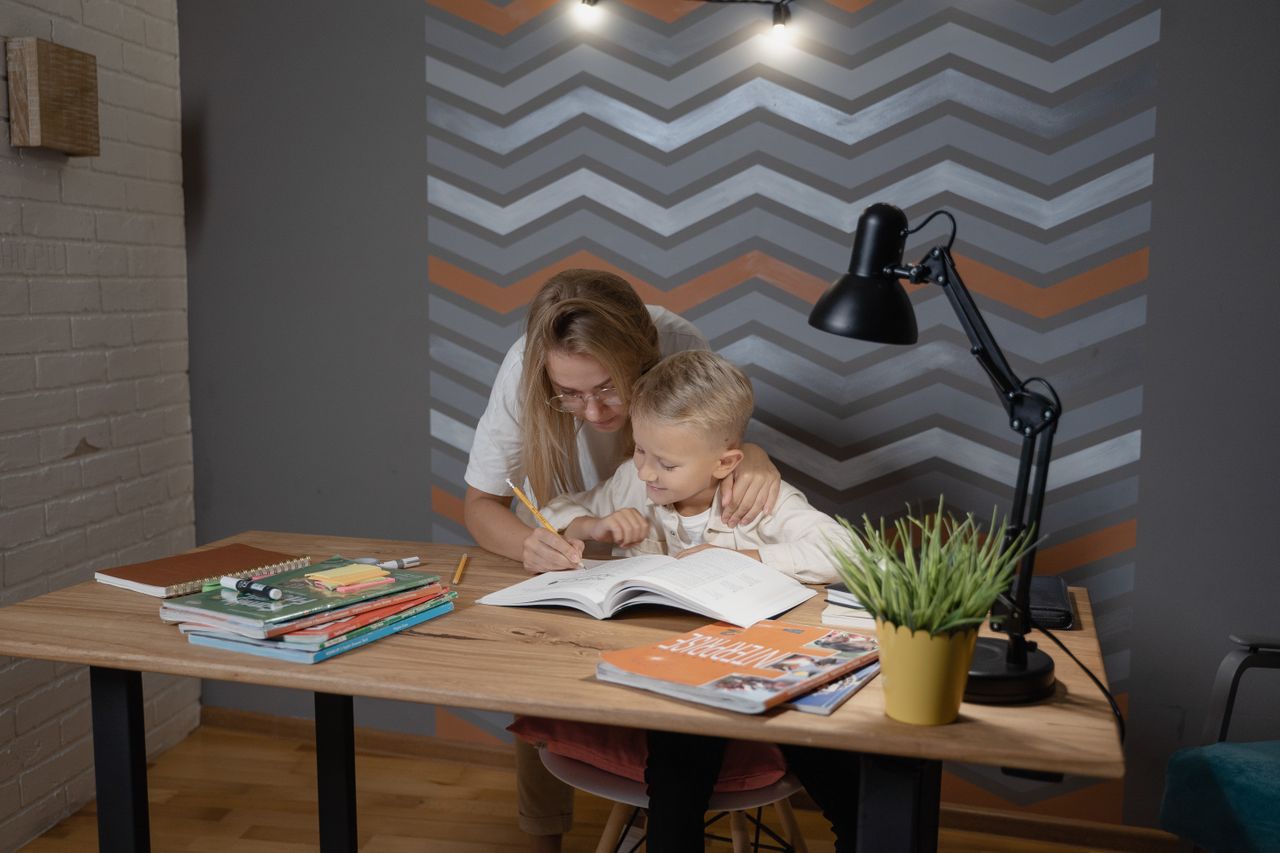
Find the morning light, then one good wall
Ask a family who has done a year of school at home what mattered most, and the answer is rarely square footage. It is light, in the room where the work happens, during the hours it happens. A bedroom on an airshaft is fine for sleeping. It is a hard place to spend four morning hours with a nine-year-old and a math workbook. So tour the room you would actually use and stand at the window. Which way does it face? East and south exposures earn their rent; a north-facing room needs every lamp you own by February.
The second requirement is a wall. Not an extra room, a wall. Families who have already chosen a homeschool curriculum arrive at the same point: shelving beats a spare room. A dining room or wide hallway with one uninterrupted six-foot stretch turns into a functioning school with a couple hundred dollars of bracketed shelving. What defeats it is a floor plan where every wall is broken by a radiator, a door, or a window. Bring a tape measure. And if the building predates 1940, as much of Boston's stock does, ask whether the walls are plaster over brick; you can hang shelves on those, but you will want to know before you sign.
Tour the building at noon, not at 7 p.m.
Most rental buildings are judged in the evening, because that is when tours happen and when most tenants live in them. A household that is home all day meets a different building. The laundry room at noon on a Tuesday is either gloriously empty or ruled by the one machine that has been broken since March. Deliveries arrive while someone is there to sign for them, an advantage, unless the buzzer means four flights of stairs every time. Contractors renovating the unit upstairs work exactly the hours school happens.
None of this appears in a listing. All of it can be learned by touring at midday and asking three questions. Is any renovation scheduled in the building? How do packages actually reach my door? Is the laundry shared by the floor or by the whole building? A super who answers plainly is telling you something beyond the answers themselves.
The lease clauses that matter when you are home all day
A standard lease assumes the unit sits empty from eight to six. A family schooling at home inverts that, and three clauses read differently as a result. Quiet-hours language usually restricts nighttime noise, but some leases add daytime provisions written with home businesses in mind. Kids doing school are not a business, and the weekday sounds of children at home are residential use, but read the clause so nothing surprises you later. Check the guest policy, since tutors, music teachers, and other families arriving weekly are routine for these households. And do the utilities math. Heat included versus tenant-paid is a different calculation when the apartment is occupied and heated all day through a Boston January; a unit two hundred dollars cheaper can erase the difference between October and April.
Map libraries and transit, not school district lines
Here is where the map gets redrawn. The classic family search starts from school assignment zones. A family schooling at home ignores those lines and anchors on different institutions: the nearest library branch, and how far one transit fare can take a parent and two kids. A branch library within a stroller walk is a second classroom, free, open six days a week. Boston is unusually rich here. The public library system runs branches in nearly every neighborhood, and library cards in the region come with discounted museum passes. The Museum of Science on a direct train is not a luxury for these families. It is Tuesday.
The practical effect: neighborhoods priced at a premium for their school assignments hold no special value, while a modest block near a good branch and a T stop holds a great deal. That is genuine arbitrage, open to anyone whose children do not attend the neighborhood school, whatever the reason.
Five checks that pay off for any renter with kids
Strip away the schooling and the list still holds. Midday light. One usable wall. A building that functions at noon. A lease read for how you actually live. A location chosen for the institutions you will use weekly rather than the ones you are zoned for. Every renter with kids benefits from at least three of the five, because every child is home sick sometimes, every school has vacation weeks, and every family spends more daylight hours at home than a childless tenant does.
The families who school at home did not discover new virtues in apartments. They just evaluate honestly what most of us judge at 5:30, in a hurry, with an agent holding the door.