What Happens If You Die Without a Will in Florida? Intestate Succession Explained
1. Intestacy applies only to probate assets
Ask one simple question first: Does the asset have to go through probate? If the answer is no, Florida’s intestacy statute (Fla. Stat. § 732.101) never touches it.
Picture two bowls on the counter.
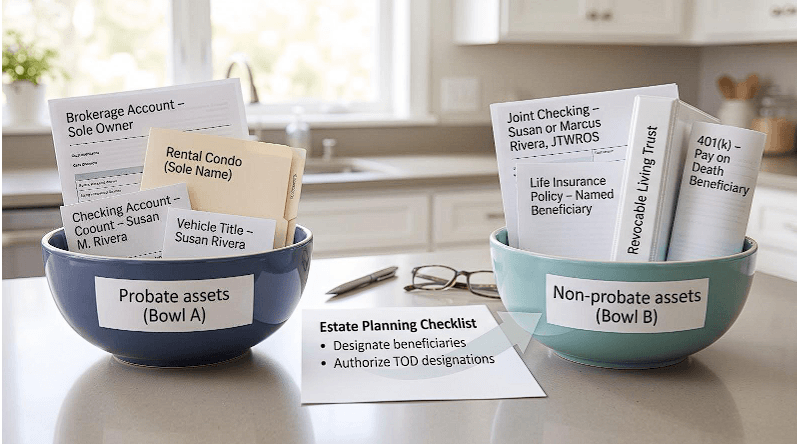
Bowl A - probate assets
Cash or property titled only in the decedent’s name, say a brokerage account labeled “Susan M. Rivera”, enters probate. Without a valid will, Florida’s heir chart decides who receives it.
Bowl B - non-probate assets
Anything with its own transfer mechanism skips the judge entirely: joint-tenancy bank accounts, life-insurance payouts, a funded revocable trust, or a 401(k) that names a living pay-on-death beneficiary.
Why focus on title instead of family? Paperwork overrides expectations. A checking account marked “Susan or Marcus Rivera, JTWROS” belongs to Marcus the moment Susan dies, even if her children assume it goes into the estate.
When wills, beneficiary forms, and accurate titles line up, Bowl A usually shrinks; that’s smart estate planning at work.
It starts with a complete inventory of assets and liabilities, the first step on any serious estate planning checklist. Designating beneficiaries and authorizing transfer-on-death registrations usually come next, and for good reason.
Keeping those forms current moves retirement accounts, life-insurance payouts, and even vehicle titles straight to the people you named, bypassing probate and leaving less in Bowl A.
A final wrinkle is partial intestacy. If Susan’s will overlooks a rental condo she bought last year, only that condo drops into Bowl A; everything the will names still follows her written directions. We’ll tackle the family-tree rules for those orphaned assets in the next section.
2. A surviving spouse may inherit all, or only half
Florida gives the spouse either 100 percent or 50 percent of the ordinary probate estate, depending on each side’s family tree (Fla. Stat. § 732.102).
| Family picture | Spouse receives | Decedent’s descendants receive |
|---|---|---|
| No descendants at all | 100 % | - |
| All children are shared, and spouse has no other children | 100 % | 0 % |
| Decedent has at least one child from another relationship | 50 % | 50 % (per stirpes) |
| All children are shared, but spouse has children from another relationship | 50 % | 50 % (per stirpes) |
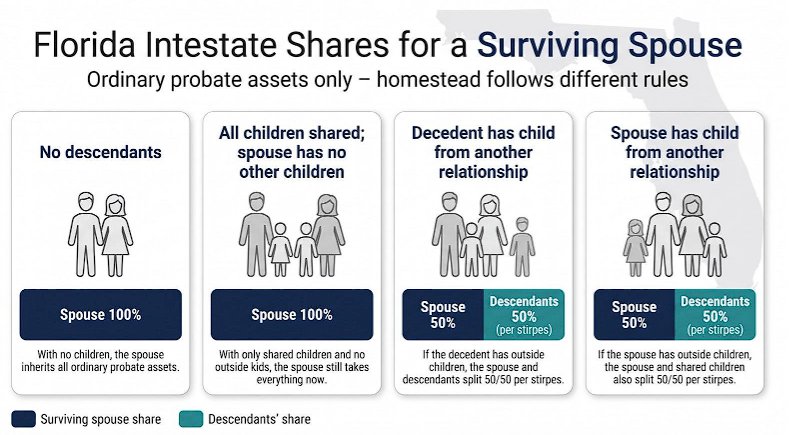
The following examples show how the percentages play out.
2.1 No descendants
Carla dies intestate in Jacksonville, leaving her husband, Miguel, and no children. Every probate asset, from her car to a sole-name brokerage account, passes 100 percent to Miguel, subject to creditor claims.
2.2 All children are shared, and spouse has none from another relationship
Tyler and Jordan share two daughters. Tyler dies first. Jordan receives the entire probate estate today; the daughters stay next in line when Jordan’s estate is settled.
2.3 Decedent has a child from another relationship
Marcus leaves his wife, Dana, their young son, and an adult daughter from a prior marriage. A $600,000 probate estate splits: $300,000 to Dana and $150,000 to each child, per stirpes.
2.4 Spouse has a child from another relationship
Lisa and Kevin share two teenage sons; Kevin also has an adult daughter from college days. Lisa’s $400,000 probate estate divides $200,000 to Kevin and $100,000 to each son.
These percentages apply to ordinary probate property only. Protected homestead and elective-share rights follow different rules covered in the next section.
3. Florida homestead follows its own inheritance rules
3.1 Why the family home plays by different rules
Florida’s constitution (art. X, § 4) treats a protected homestead as more than just another asset: creditors have limited reach, and intestacy shares change entirely. The spouse and child percentages in Section 2 apply to ordinary probate property, not automatically to the homestead.
By default, Fla. Stat. § 732.401 gives:
- the surviving spouse a life estate (the right to live in or rent the home for life), and
- the decedent’s descendants a vested remainder (they hold tomorrow’s deed today).
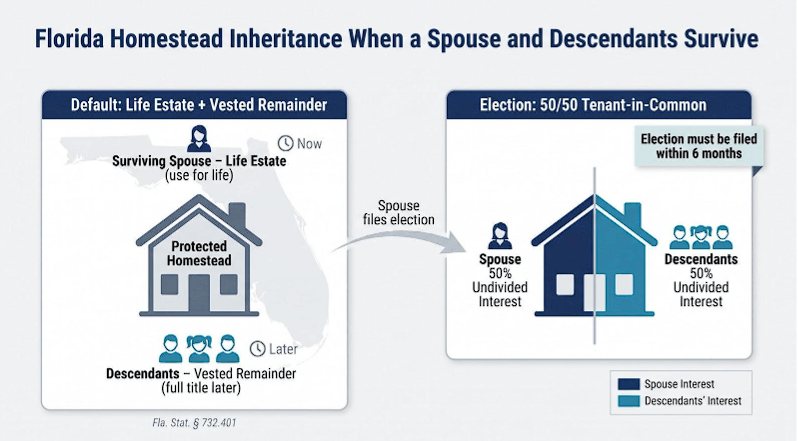
3.2 Spouse and descendants: life estate now, full title later
Assume the homestead is worth $450,000. The spouse may live there, refinance, or lease the property but cannot sell the fee simple without the remainder owners joining. If the house later sells for $500,000, the proceeds split between:
- the spouse’s life-estate value, calculated from IRS actuarial tables tied to the spouse’s age, and
- the children’s remainder value.
Want a clean exit? File the election and own the home 50-50 with the descendants; any sale then divides cash along that straight line.
If no descendant survives, different rules apply. In that case the spouse usually takes the home outright. We cover that scenario next.
4. Descendants inherit by branch, and legal parentage decides who sits on each branch
4.1 Per stirpes: how Florida divides the family tree
Florida distributes through per stirpes (Fla. Stat. § 732.104): each bloodline gets an equal slice, then that slice splits among the heirs in that branch.
Example. Maria dies intestate with a $180,000 probate estate and three children. Each receives $60,000. One son, Luis, predeceases her and leaves two children. Luis’s $60,000 share now divides $30,000 to each grandchild, while the other two children still receive $60,000 apiece.
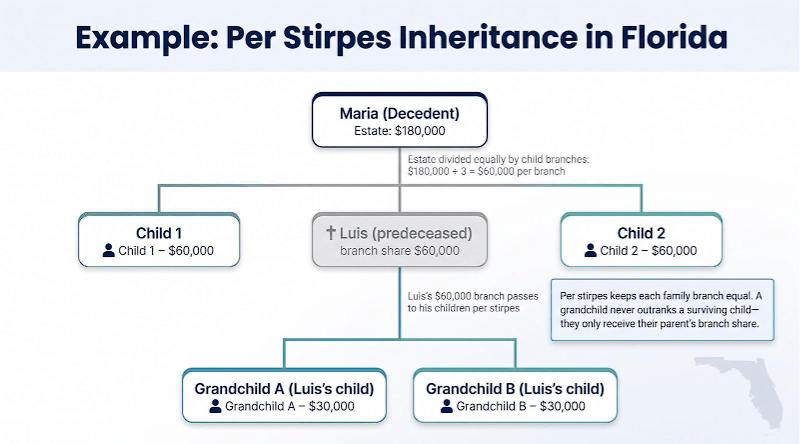
Why does Florida use this method? It keeps every branch in parity; a grandchild never outranks a surviving child.
4.2 Who counts as a child? Adoption, paternity, posthumous births
The court confirms legal parentage before running the numbers:
- Adopted children inherit exactly like biological ones once the decree is final (Fla. Stat. § 732.108).
- Children born outside marriage inherit when paternity is established by acknowledgment or court order; DNA evidence may be required if records are missing.
- Conceived before death, born after: treated as living when the parent died (Fla. Stat. § 732.106).
- Conceived after death with stored genetic material: generally do not inherit unless a will provides (Fla. Stat. § 742.17(4)).
- Terminated parental rights cut inheritance both up and down the line.
Takeaway for you: the relatives at the memorial may not match the heirs on paper. Confirm legal status early so money flows to the right branch.
5. Stepchildren, partners, and charities are not on Florida’s automatic heir list
5.1 Stepchildren: love counts, the statute does not
Florida’s intestacy ladder ends at legal relationships. A stepchild you raised is invisible to the probate court unless you adopted that child or named them on a beneficiary form (see Fla. Stat. §§ 732.102-.108). Many families learn this after a judge treats the stepchild like a friendly neighbor at the service but not an heir to a $200,000 sole-name brokerage account.
If you want a different outcome, put it in writing now. Options include formal adoption, a beneficiary designation, or even a simple will. Probate can only follow the paperwork that already exists.
5.2 Unmarried partners, friends, and favorite causes
Intestacy reads like a short guest list: spouse, blood relatives, adoptees. Unmarried partners, college roommates, and favorite nonprofits receive zero by default. Judges look for a marriage certificate, adoption decree, or named beneficiary. Without one of those documents, the court has no legal basis to redirect probate dollars, no matter how compelling the story.
The fix is straightforward and inexpensive. Add the partner as a pay-on-death beneficiary to a bank or retirement account, place both names with survivorship rights on a deed, or sign even a modest will. Charities need the same treatment; an obituary request does not transfer legal ownership.
Bottom line for you: goodwill is not a transfer mechanism. If you want anyone outside the statutory heir list to inherit, make it official before life’s paperwork ends.
6. Parents, siblings, and distant kin stand in line before the state
6.1 When no spouse or descendants survive, parents move to the front
If there is no surviving spouse and no lineal descendant, Florida drops one rung to the decedent’s parents (Fla. Stat. § 732.103). One or both living parents split the probate estate equally.
Example. Sam dies intestate with a $120,000 probate estate and no spouse or children. His mother is alive, his father is deceased, so Mom inherits the full $120,000.
If both parents have already passed, the estate steps sideways to siblings. A deceased sibling’s share passes per stirpes to that sibling’s children (your nieces or nephews). Only after the court checks grandparents, aunts, uncles, cousins, and even kindred of a predeceased spouse does property escheat to the State School Fund (Fla. Stat. §§ 732.105 and 732.107). Heirs may reopen an escheated estate for up to ten years.
Takeaway for you: Florida almost never wins. A distant cousin in another state will beat the government if they can prove the bloodline.
6.2 The collateral ladder: siblings, nieces, nephews, and beyond
No parents alive? Living brothers and sisters divide the estate equally. A predeceased sibling’s children take that branch’s share. Still no takers? The court backs up a generation to grandparents, then forward again to aunts, uncles, and first cousins. Half-blood relatives are not shut out. Under Fla. Stat. § 732.105 they take half as much as whole-blood relatives of the same degree when both survive, and if every surviving collateral relative is half blood, they share equally.
If every statutory branch is empty (a rarity), the estate finally escheats. Yet even then, a qualified heir may file within the ten-year window and recover funds held for the State School Fund.
Bottom line for families: Florida keeps property only when the family tree is truly barren.
7. The court chooses the personal representative, not the oldest child
7.1 Appointment priority and basic qualifications
Florida law selects the estate’s personal representative by statute, not by birth order or zip code (Fla. Stat. §§ 733.301-.304). The judge works through this list:
- Surviving spouse. The spouse goes first if willing, qualified, and either a Florida resident or a close-kin non-resident (child, parent, sibling, and so on).
- Heir majority choice. If the spouse declines, a majority of heirs may nominate anyone who meets the basic requirements.
- Nearest heir in degree. Without consensus, the judge offers the role to the closest heir (children, then parents, then siblings).
Every nominee must be at least 18, mentally competent, and free of felony convictions. Florida also shuts most non-residents out entirely. Under Fla. Stat. § 733.304 a non-resident may serve only as an adopted child or adoptive parent, a lineal blood relative, or a spouse, sibling, uncle, aunt, nephew, or niece of the decedent (or the spouse of someone in one of those categories). An out-of-state cousin or a business partner cannot qualify at all, and no bond or co-representative fixes it.
Why should you care? The personal representative opens the estate, gathers statements, lists property, pays creditors, and files tax returns. A diligent pick speeds probate, while a disorganized one can drag a simple case for months. The July 1, 2026 reforms let modest estates use the new $150,000 shortcut only after the representative files complete paperwork.
If no qualified family member steps up, the judge may appoint a bank, lawyer, or professional fiduciary. Their fees come from the estate under the compensation rules discussed later.
8. Small-estate shortcuts widened on July 1, 2026
8.1 Summary administration now tops out at $150,000
Chapter 2026-57 doubled Florida’s summary-administration ceiling from $75,000 to $150,000 for deaths on or after July 1, 2026 (Fla. Stat. § 735.201, as amended). The limit applies to the net value of probate assets, after subtracting exempt household property and protected vehicles. A protected homestead is usually excluded.
Illustration. An estate holds a $140,000 checking account, a $40,000 car that qualifies as exempt, and a protected homestead. Net probate value: $140,000. The estate qualifies for summary administration without waiting two years.
Key points for you:
- The court issues an order of summary administration instead of letters. Most banks accept the order; a few still ask for letters, so build extra time into your timeline.
- If the decedent has been dead more than two years, the $150,000 cap no longer matters and any size estate may use summary administration.
The same 2026 law expanded micro-estate tools:
- Up to $20,000 of specified intestate personal property can transfer by petition one year after death (Fla. Stat. § 735.304).
- A family member may collect up to $2,000 on deposit at a bank by affidavit (Fla. Stat. § 735.303).
All three figures ($150,000, $20,000, and $2,000) were half as large before July 1, 2026.
Next, we compare summary and formal administration so you can weigh speed, cost, and documentation requirements.
9. Creditors line up ahead of heirs
9.1 The publication clock starts ticking on day one
Before anyone divides heirlooms, Florida law requires the personal representative to publish a notice to creditors (Fla. Stat. § 733.2121). Most creditors then have three months to file a claim. A creditor who receives direct service has 30 days or the balance of that period, whichever is longer (Fla. Stat. § 733.702). File late and the claim is usually barred. The rule shields families from surprise lawsuits and forces legitimate bills such as hospital charges, final-month rent, and utility arrears to surface while money is still in the estate.
If you pull cash out too soon, the court may order you to return it. Waiting out the claim window avoids that boomerang.
9.2 Florida’s payment waterfall
When valid claims arrive, the personal representative pays them in the statutory order set by Fla. Stat. § 733.707, top class first, bottom class last.
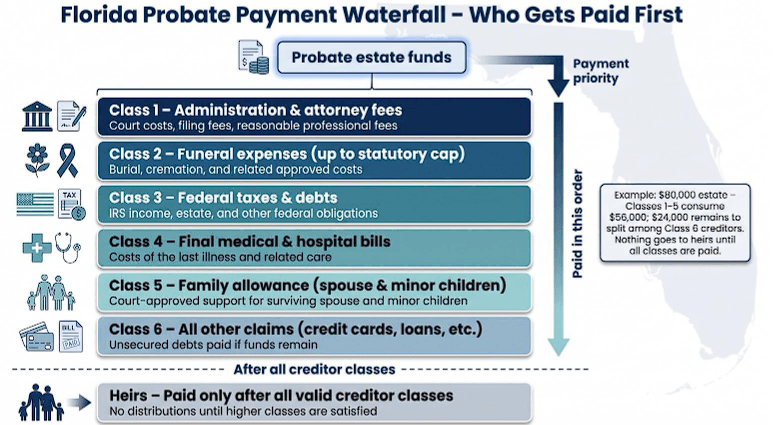
- Administration costs and attorney fees. Filing fees, publication costs, and reasonable professional charges.
- Reasonable funeral, interment, and grave-marker expenses, capped at $6,000 in total.
- Federal taxes and debts. The IRS stands ahead of everyone except funeral homes and the court itself.
- Final medical and hospital bills. Costs of the last illness.
- Family allowance for a surviving spouse or minor children.
- Overdue child support obligations.
- Debts acquired after death through continuation of the decedent’s business.
- All other claims. Credit cards, personal loans, and business debts, paid pro rata if money remains.
Illustration. An estate holds $80,000. Class 1 expenses total $6,000; funeral costs $6,000; federal taxes $5,000; final medical bills $20,000; family allowance $18,000. That leaves $25,000 for Class 8 creditors, who split it pro rata. Nothing flows to heirs until every higher class is satisfied.
Heirs are not personally liable unless they took estate property early. Clearing or barring claims first keeps the family from inheriting Dad’s Visa bill.
10. Most Florida probates wrap in six to twelve months and here’s why
10.1 A realistic month-by-month roadmap
Formal administration usually spans six to twelve months. The timeline leaves room for Florida’s three-month creditor window (Fla. Stat. § 733.702) plus real-estate or tax chores, yet well-prepared families can still finish within a year.
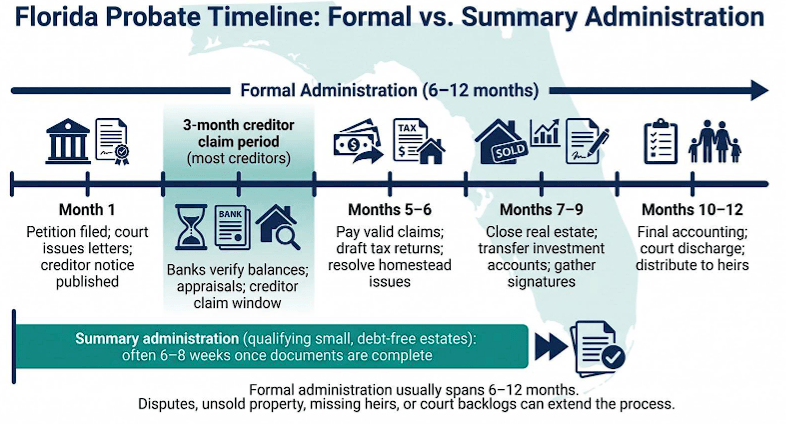
- Month 1. You file the petition, and the court issues letters to the personal representative; the creditor notice heads to the newspaper.
- Months 2-4. Banks verify balances, appraisers value property, and the claim clock keeps ticking.
- Months 5-6. Valid debts are paid, tax returns drafted, and any homestead title issues resolved.
- Months 7-9. Real estate closes, brokerage accounts transfer, and beneficiary signatures roll in; disputes can add weeks.
- Months 10-12. The final accounting circulates, the judge signs a discharge order, and heirs receive what is left.
Compare that with a debt-free estate that qualifies for summary administration. The same work collapses into a few filings and can finish in six to eight weeks once documents are complete.
Variables such as creditor objections, unsold property, missing heirs, or clerk backlogs push the calendar to the right. Plan on most of a year, celebrate if it ends sooner, and avoid scheduling a home-sale closing the week after filing.
11. Probate costs extend far beyond a clerk’s filing fee
11.1 Statutory fee schedules are guidelines, not price tags
Florida’s fee charts in Fla. Stat. §§ 733.617 and 733.6171 create only a presumption of reasonableness; they are not mandates. If an attorney plans to charge the presumptive statutory fee, Florida law requires written disclosures that explain there is no mandatory fee and that every fee is negotiable.
What does that mean for you? A lawyer can:
- quote less than the table,
- charge a flat amount for a summary administration, or
- waive ordinary compensation and bill only for extraordinary work.
Example. A $140,000 probate estate might show a presumptive ordinary attorney fee of $4,200 under § 733.6171, yet a lawyer could agree to handle a straightforward summary administration for $2,000, or even less if most documents are ready.
Keep a mechanic’s-rate mindset: ask for an estimate, question extras, and shop around.
Remember, filing fees, publication notices, certified copies, appraisals, and bond premiums can match or exceed professional fees in modest estates. We break down those real-world charges next.
12. Minor heirs need a guardian of property, not just a guardian of the person
12.1 Who controls a child’s inheritance?
Florida separates raising a child from managing the child’s money. When a minor inherits under intestacy, the probate judge must appoint a guardian of the property unless the amount is small. A natural guardian may receive and manage up to $15,000 for the child without a court-appointed guardian of the property (Fla. Stat. § 744.301(2)); above that figure, the court must appoint one. That guardian, often but not automatically the surviving parent, must post bond, file an inventory, and submit annual accountings until the child turns 18 (Fla. Stat. §§ 744.351, 744.365, 744.3675). Once the birthday arrives, the guardianship ends and the 18-year-old gains full control of the assets (Fla. Stat. § 744.521).
Example. A 14-year-old inherits a $150,000 half-interest in the family home. To sell or refinance, the parent-guardian must petition the guardianship court and prove the deal benefits the child, adding cost and delay that a simple custodial trust could have avoided.
Estate-planning workaround: a will or living trust can route the same assets into a Uniform Transfers to Minors Act account or a minor’s trust, sidestepping guardianship court, trimming fees, and delaying payouts past an impulsive eighteenth birthday.
Takeaway for you: intestacy hands kids immediate ownership, but only inside a court-supervised wrapper most families do not expect.
13. Digital assets can vanish if no one holds the keys
13.1 Florida’s access hierarchy
Florida’s Fiduciary Access to Digital Assets Act (Fla. Stat. ch. 740) ranks four sources of authority, starting with the one you control most directly.
- Online tool first. A Google inactive-account manager or Apple legacy contact overrides every other document.
- Estate documents next. A will or trust can grant, limit, or deny access when no contradictory online tool exists.
- Terms of service. If you leave no instructions, the platform’s contract governs; some providers flatly bar fiduciary entry.
- Probate court order. A judge may compel disclosure, but the process is slow and usually public.
Cryptocurrency raises the stakes. The statute can declare an heir the rightful owner, yet the blockchain still needs the private key. A lost seed phrase on a $25,000 Bitcoin wallet is gone forever because legal entitlement alone cannot unlock it.
Action step for you: store passwords and seed phrases in an encrypted vault, and tell your personal representative where to find the instructions. Otherwise, heirs may inherit nothing more than an expensive USB stick.
14. No Florida estate tax, yet the IRS still matters
14.1 Federal estate-tax threshold and portability
Florida repealed its pick-up estate tax in 2005, but the federal tax remains. For deaths in 2026, the basic exclusion is $15 million per person (Internal Revenue Code § 2010(c); Rev. Proc. 2025-32). Most families sit below that ceiling, yet large life-insurance payouts, retirement accounts, and highly appreciated real estate can push a high-net-worth estate into filing territory.
Married couples can double the shield through portability. If the first spouse dies with $4 million of unused exclusion, the survivor may add that amount to their own and shelter up to $19 million, but only by filing Form 706 to elect portability. The return is due nine months after death, with a six-month extension available on request. An estate that was not otherwise required to file can still make a late election for up to five years after death under a simplified IRS procedure, but do not plan around that safety net. File on time.
Keep this in mind: inheritances are not income, yet future capital-gains bills depend on a correct stepped-up basis at death. Skipping a date-of-death appraisal now could cause heirs to overpay tax when they sell later.
Routine tax chores still apply. You will need the decedent’s final Form 1040, any fiduciary income-tax returns, and ordinary income tax on distributions from an inherited IRA. A short meeting with a CPA early in the process can prevent costly surprises.
15. Community-property history and out-of-state real estate can change the analysis
15.1 Tracing community property brought from another state
Florida follows equitable distribution, yet many residents built wealth in community-property states such as California or Texas. Under the 2024 amendments to Fla. Stat. §§ 732.216-.228 (Ch. 2024-238, Laws of Fla.), any asset that can be traced to community earnings stays 50-50 at death. The surviving spouse already owns half outright, and only the decedent’s half enters probate.
Example. Mia and Carlos earned a $200,000 brokerage account while living in Houston. The account is titled in Mia’s name alone when they retire to Tampa. Mia dies intestate. Carlos first claims his $100,000 community half as separate property. Only the remaining $100,000 joins the probate estate for distribution under Florida’s intestacy rules. Title alone no longer controls; marital origin does.
The statute sets a two-year repose period. Wait longer to raise a community-property claim and you lose the argument. If you moved to Florida from a community-property state, inventory old accounts now instead of forcing heirs to reconstruct twenty-year-old statements later.
Out-of-state real estate follows the law of its location. A Colorado mountain cabin or a New York condo will likely require a separate ancillary probate in that state, each with its own fees and timelines, before the property can be sold or retitled. Talk with a local attorney early so closing dates and listing agreements stay on track.
16. An intestate home can splinter into “heirs’ property” over generations
16.1 Why co-owned titles stall sales and shrink equity
If you die without a will, a single Florida homestead can pass to five, ten, or even twenty descendants at once. Fast-forward one generation and the title looks like a patchwork quilt: cousins, half-siblings, and far-flung relatives each hold tiny percentages of the same $300,000 house. No one can refinance or sell without unanimous consent, and a single holdout can derail a closing.
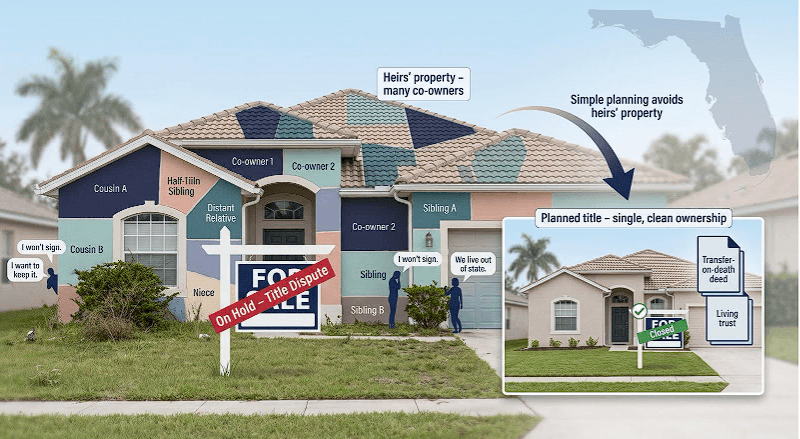
Banks hesitate to lend, buyers lower their offers, and even routine repairs become committee decisions. When talks fail, any co-owner may file for a court-ordered partition. Under Florida’s Uniform Partition of Heirs Property Act (Fla. Stat. ch. 64, part II), the court must order an appraisal, offer buy-outs, and list the property on the open market before sending it to auction. Litigation costs and forced-sale discounts can still drain tens of thousands of dollars in family equity.
Prevention costs far less than the cure. A simple transfer-on-death deed, beneficiary designation, or living trust keeps ownership consolidated and the title marketable for future buyers.
Intestacy does more than delay probate; it can trap generations in real-estate gridlock. A little planning today keeps tomorrow’s heirs from facing that bottleneck.
Conclusion
Dying without a will in Florida does not mean your property goes unclaimed. It means the statute decides, and the statute does not know your family. It cannot see the stepchild you raised, the partner you never married, or the house you always meant to put in your daughter's name.
Every scenario above traces back to the same root. Someone assumed the law would arrive at the obvious answer, and it arrived at a different one. Probate then made that answer expensive and slow.
The fixes are ordinary. Name beneficiaries on every account. Check that titles and deeds say what you think they say. Put a will or a trust in place and revisit it when the family changes. A few hours of estate planning now spares your heirs years of court, legal fees, and arguments they cannot undo.