The Flat Headstone and the Modern Cemetery: Why This Simple Form Outlasted Everything
Strip a cemetery of everything except its stones. Remove the paths, the trees, the fences, the chapel silhouettes. What remains is a field of vertical and horizontal shapes in conversation with each other — a spatial composition nobody consciously designed but that has recognizable visual logic nonetheless.
The flat headstone — flush with or barely above the turf, polished on the exposed face, invisible from more than a few feet away — represents one end of that compositional range. The soaring obelisk, the arched upright monument, the carved bench memorial, represent others. What the flat form does that vertical stones don't is remove itself from the landscape rather than insert itself into it. The grave is there. The marker confirms the grave. The landscape continues around it.
This was not always considered a virtue.
The Lawn Cemetery Movement and Its Critics
The lawn cemetery movement of the 19th century — largely credited to Adolph Strauch's transformation of Spring Grove Cemetery in Cincinnati, Ohio in the 1850s — introduced the idea that a burial space could be beautiful in the way a park is beautiful: continuous, unified, not fragmented by the visual noise of competing monuments of varying heights and styles. Flush markers, or low-profile stones set at a consistent height, were part of this vision. They allowed continuous turf management. They subordinated the individual grave to the larger composition.
That was controversial. Many families felt — and still feel — that a visible, standing monument is the appropriate expression of the care taken for a person's memory. The flat headstone arguments were utilitarian, spatial, institutional. The upright monument arguments were personal.
Both remain valid. And in most American cemeteries, both exist.
Design Range Within the Flat Format
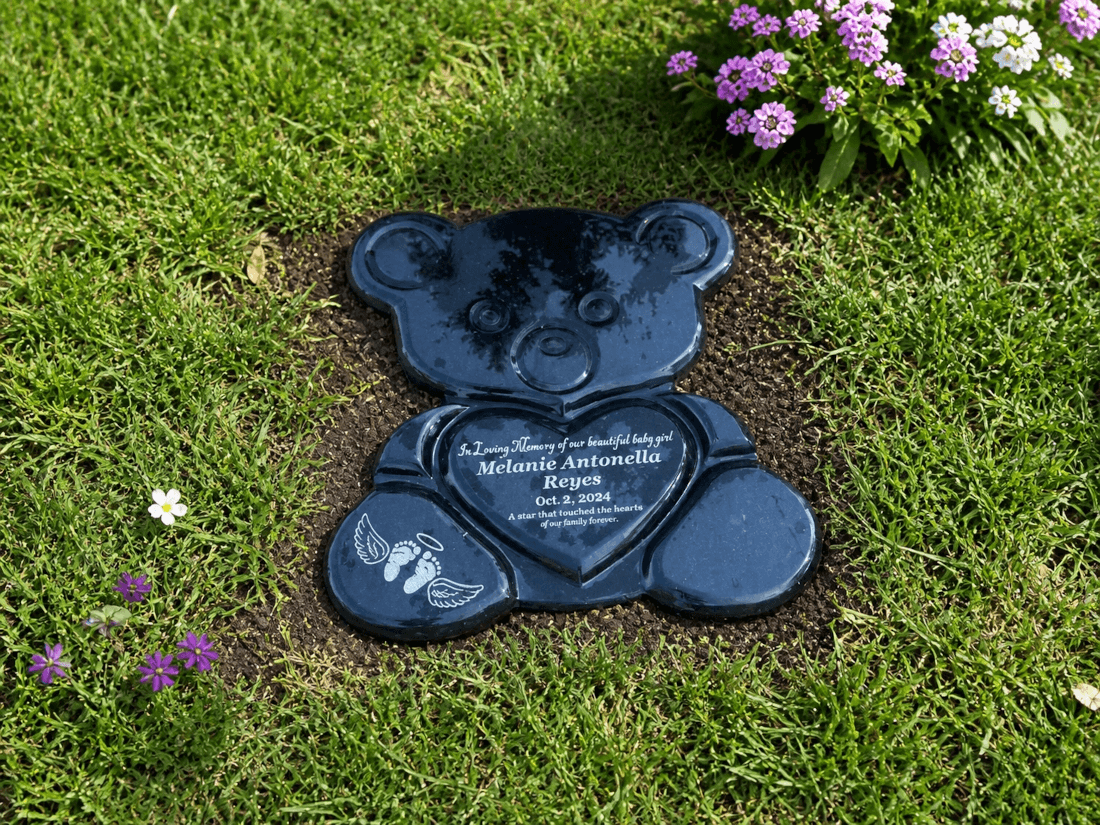
What's changed in recent decades is the design range available within the flat format. A flush granite marker from 1960 was almost inevitably a plain rectangle with sandblasted text. The same format in 2025 can carry a laser-etched photographic portrait, a heart or diamond or star silhouette, a full botanical illustration across the surface, an embedded ceramic photo medallion, or a carved bas-relief that lifts the imagery above the flat plane in three dimensions.
Material Choices and Long-Term Readability
The material options have expanded further. Indian Black Premium, Shanxi Black, Blue Pearl from Norway, Balmoral Red from Finland, Carrara White, India Mahogany — each has its own visual character as a flat surface, and each presents a different canvas for engraving. High-contrast stones like Indian Black make engraved white text read from standing distance in any light. Paler stones like Carrara White take a different engraving technique and produce a subtler, more luminous effect. Material choice is not just aesthetic — it also determines long-term readability, which matters for a piece expected to be present at a grave for a hundred years.
The flat headstone's staying power isn't mysterious, exactly. It solves a real problem — compatibility with modern cemetery maintenance requirements — while making room for an unusually wide range of personal expression. A family in California or Florida choosing a flush marker because the section requires it gets to make that choice in any of 40-plus granite types, any number of shapes, and any design from a monogram to a full portrait.
Production Technology and Family Preview
The production reality behind that range involves CNC engraving systems for letter precision, laser systems for portrait detail, and 3D design software that places the full render of the finished marker on the actual granite surface for family review before production begins. The AR visualization that some manufacturers now offer extends this further — the stone appears at actual scale in a real environment through a phone camera. For families in Pennsylvania, Ohio, Texas, North Carolina, Washington, or anywhere the flat marker is the section standard, that preview capability represents a meaningful reduction in the risk of post-installation regret.
The compositional argument for the flat headstone hasn't changed since Strauch's time: the landscape continues, the grave is present but not insistent, the space breathes. Whether a family chooses that form for philosophical reasons or because the cemetery requires it, the design options now available within the flat format make the choice feel less like a constraint.
Remembrance Headstones produces flat markers across all standard sizes and custom shapes in granite types sourced from quarries across India, China, Norway, Finland, Brazil, and the United States. Full design, production, and installation service for families across California, Texas, Oklahoma, Florida, Pennsylvania, North Carolina, Illinois, and New Jersey. Start at remembranceheadstones.com.