How Do Gate Openers Work? A Complete Guide
Automatic gate openers have become an essential part of modern homes and businesses. They provide convenience, security, and smoother access control for residential driveways, commercial properties, farms, and gated communities. Instead of manually opening and closing a heavy gate every time you enter or leave, a gate opener automates the process with the push of a button, a keypad code, or even a smartphone app. Understanding how gate openers work can help homeowners choose the right system and maintain it properly for long-lasting performance.
What Is a Gate Opener?
A gate opener is a motorized device designed to automatically open and close a gate. These systems use electric motors, control boards, and mechanical components to move gates safely and efficiently. Gate openers can operate different styles of gates, including swing gates and sliding gates, and are commonly used to improve both security and convenience.
Modern gate opener systems can be controlled through various access methods such as remote controls, wireless keypads, vehicle sensors, intercom systems, and smart mobile applications. Some advanced systems can even integrate with smart home security setups for remote monitoring and control.
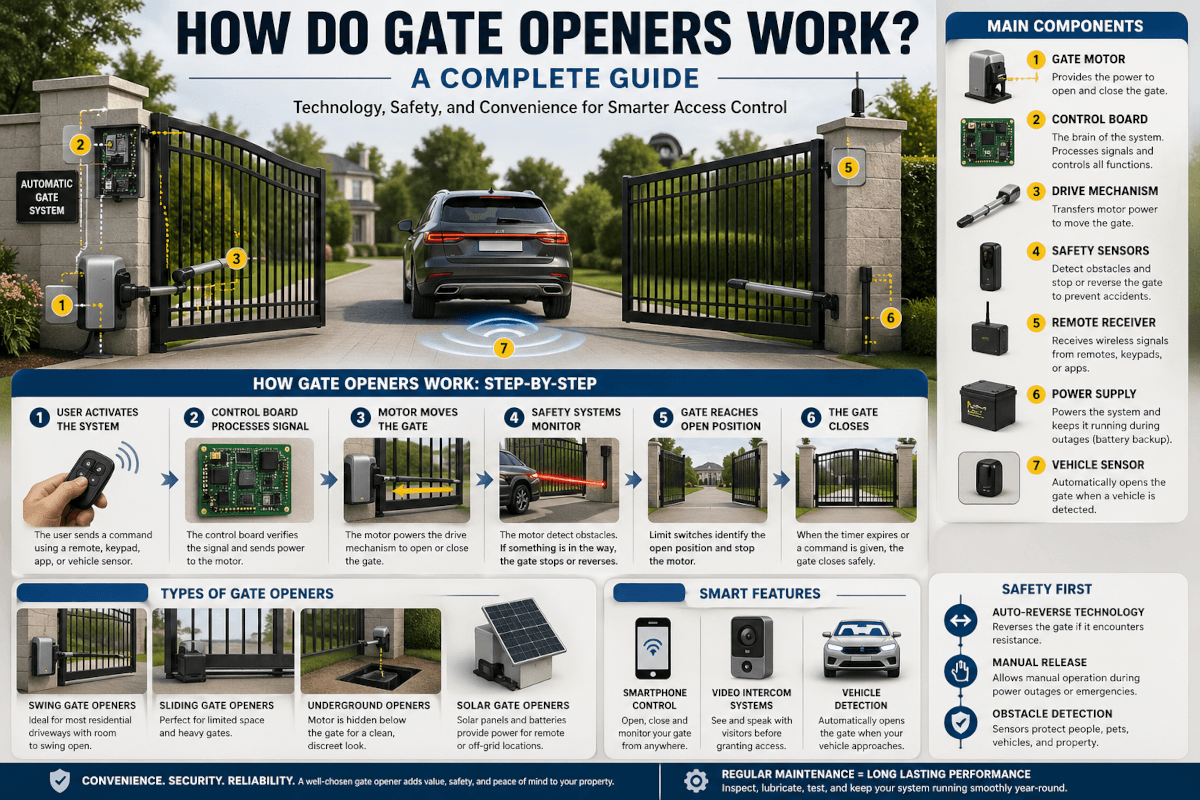
Main Components of a Gate Opener System
Understanding the main parts of a gate opener system helps explain how the entire mechanism operates.
Gate Motor
The motor is the central component of the system. It generates the power required to move the gate open and closed. Depending on the type of gate, the motor may operate an articulated arm, rotate gears, pull a chain, or drive a track system. Most residential systems use electric motors, while some rural properties rely on solar-powered systems with battery backup.
Control Board
The control board acts as the brain of the gate opener. It receives signals from remotes, keypads, smartphone apps, or sensors and determines when the gate should open or close. The control board also manages important functions such as automatic closing timers, obstacle detection, motor speed, and safety systems.
Drive Mechanism
The drive mechanism physically moves the gate. Different gate styles use different drive systems.
Swing Gate Mechanisms
Swing gate openers use linear actuators or articulated arms to push and pull the gate open like a traditional door. These systems are popular for residential driveways because they operate smoothly and quietly.
Sliding Gate Mechanisms
Sliding gate openers use a motor-driven gear that engages with a rack attached to the gate. The gate slides horizontally along a track or cantilever system, making this design ideal for properties with limited driveway space or heavy gates.
Safety Sensors
Safety sensors play a critical role in preventing accidents and damage. Most automatic gate systems include photo-eye sensors or obstacle detection systems that monitor the gate’s path during operation. If an object, vehicle, child, or pet is detected, the gate will stop or reverse direction automatically.
Remote Receiver
The receiver communicates with wireless devices such as remotes and smartphone apps. When a valid signal is received, the control board activates the motor. Many modern systems use rolling-code technology to improve security and prevent signal theft.
Power Supply
Most gate openers operate using standard electrical power, but many systems also include battery backup or solar charging systems. Battery backup allows the gate to continue functioning during power outages, which is especially important for security and emergency access.
How Do Gate Openers Actually Work?
Although different systems vary slightly, most automatic gate openers follow the same basic operating process.
Step 1: The User Activates the System
The process begins when the user sends a command to the gate opener. This may happen by pressing a remote-control button, entering a code on a keypad, opening a smartphone app, or triggering a vehicle sensor.
The signal is transmitted to the gate opener’s receiver, which passes the information to the control board.
Step 2: The Control Board Processes the Signal
Once the control board receives the signal, it verifies that the command is authorized. If the signal is valid, the control board sends electrical power to the motor and initiates the opening sequence.
Modern systems may also check additional settings such as security permissions, scheduled access times, or smart home integrations before activating the gate.
Step 3: The Motor Moves the Gate
The motor powers the drive mechanism to move the gate.
How Swing Gates Move
For swing gates, the motor extends or retracts a mechanical arm that pushes or pulls the gate inward or outward. The gate moves in an arc similar to a standard door.
How Sliding Gates Move
For sliding gates, the motor rotates a gear connected to a metal rack mounted along the gate. This causes the gate to slide sideways across the entrance.
Step 4: Safety Systems Monitor the Gate
During operation, safety sensors constantly monitor the gate area. If an obstacle is detected, the gate immediately stops or reverses direction to avoid injury or damage. This safety feature is especially important in homes with children, pets, or frequent vehicle traffic.
Step 5: The Gate Reaches Its Open Position
Limit switches or magnetic sensors determine when the gate has fully opened. Once the correct position is reached, the control board shuts off power to the motor.
Some systems remain open until another command is received, while others automatically close after a preset time delay.
Step 6: The Gate Closes
When the system receives a closing command or the auto-close timer expires, the motor reverses direction and moves the gate back to its closed position. Safety sensors remain active throughout the closing cycle to prevent collisions.
Types of Gate Openers
Different properties and gate designs require different opener systems.
Swing Gate Openers
Swing gate openers are one of the most common options for residential properties. They work best on flat driveways with enough space for the gate to swing open fully. These systems offer quiet operation and an attractive appearance but require clearance space behind the gate.
Sliding Gate Openers
Sliding gate openers are ideal for properties with limited space or heavy gates. Since the gate moves sideways instead of swinging outward, sliding systems are commonly used in commercial and industrial settings. They also perform better in areas with strong wind.
Underground Gate Openers
Underground systems hide the motor beneath the gate, preserving the appearance of decorative entrances. These systems are popular for luxury homes because they are discreet and quiet, although installation and maintenance costs are usually higher.
Solar Gate Openers
Solar-powered gate openers use solar panels and rechargeable batteries to operate the system. They are especially useful for farms, ranches, and remote properties where running electrical wiring may be difficult or expensive.
Smart Features in Modern Gate Openers
Technology has significantly improved automatic gate systems in recent years. Many modern gate openers now include smart features that improve convenience and security.
Smartphone Control
Wi-Fi-enabled systems allow homeowners to control their gates remotely using mobile apps. Users can open or close the gate, monitor activity, and grant temporary access to guests from virtually anywhere.
Video Intercom Systems
Many gate openers integrate with video intercoms, allowing property owners to see and speak with visitors before granting access. This feature adds another layer of security and convenience.
Vehicle Detection Systems
Automatic exit sensors detect approaching vehicles and open the gate automatically when leaving the property. These systems eliminate the need to manually activate the opener when exiting.
Gate Opener Safety Features
Safety is one of the most important aspects of any automatic gate system.
Auto-Reverse Technology
If the gate encounters resistance while moving, the system automatically reverses direction to reduce the risk of injury or damage.
Manual Release Mechanism
Most gate openers include a manual release feature that allows users to open the gate manually during emergencies or power failures.
Obstacle Detection
Sensors continuously monitor the gate’s movement path to prevent collisions with vehicles, people, or objects.
Maintenance Tips for Gate Openers
Proper maintenance helps extend the lifespan of a gate opener system and ensures reliable operation.
Lubricate Moving Parts
Regularly lubricate hinges, chains, rollers, and tracks to reduce wear and maintain smooth movement.
Inspect Safety Sensors
Keep sensors clean and properly aligned to ensure accurate obstacle detection.
Check Electrical Connections
Inspect wires and connectors for corrosion, loose connections, or damage that could affect system performance.
Test Battery Backup
Battery systems should be tested regularly and replaced when necessary to ensure operation during power outages.
Final Thoughts
Gate openers work by combining electric motors, control systems, drive mechanisms, and safety technologies to automate gate movement. Whether using a swing gate, sliding gate, or solar-powered system, automatic gate openers provide improved convenience, enhanced security, and efficient property access control.
With advancements in smart technology, today’s gate opener systems are more reliable and user-friendly than ever before. Choosing the right gate opener depends on factors such as gate size, available space, power source, and security needs. With proper installation and regular maintenance, a quality gate opener can deliver smooth and dependable performance for many years.