What you need to know about site preparation before building a house in the Boston suburbs
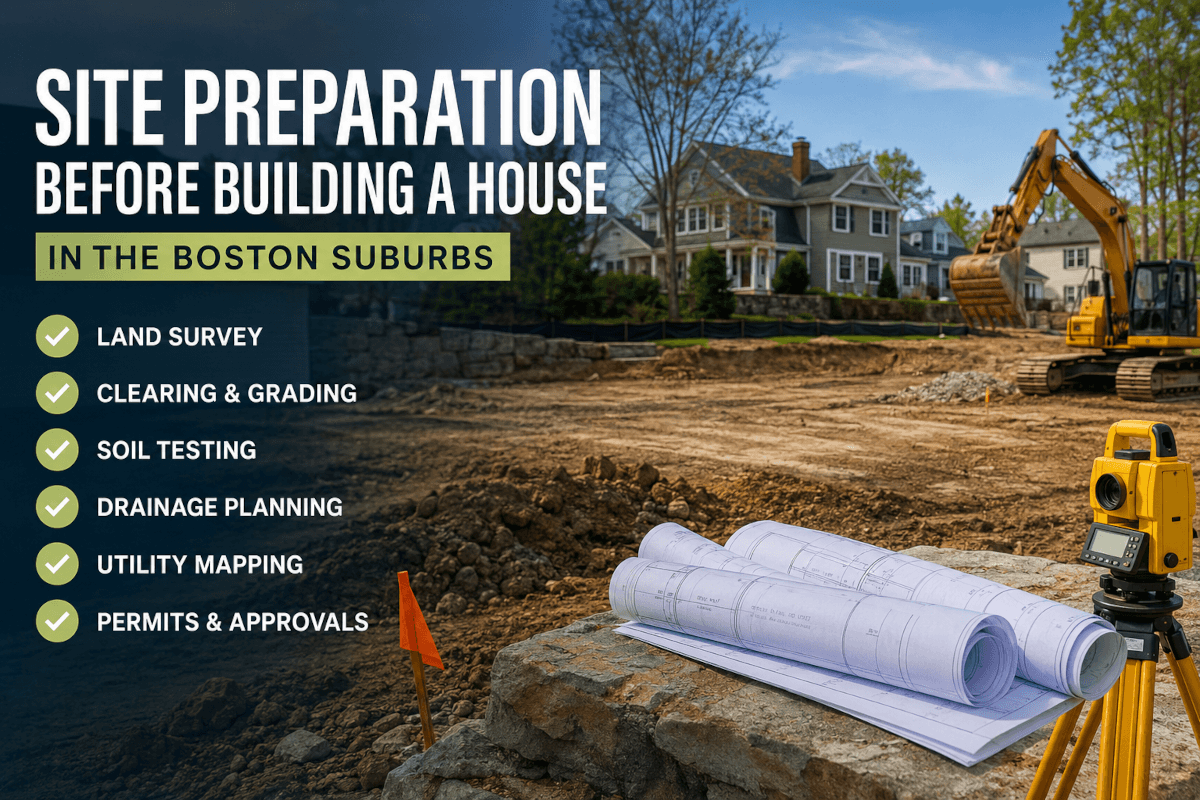
Before you call a builder or pick out floor plans, there is one step that determines whether your entire project goes smoothly or turns into a financial nightmare: getting the land ready. In the Boston suburbs, this is more involved than most people expect. Rocky glacial soil, clay layers, wetland buffers, strict local zoning, and unpredictable drainage all turn what sounds like a simple clearing job into a multi-week, multi-permit process. The short answer is this: before a single shovel goes into the ground, you need a land survey, clearing and grading, soil testing, erosion controls, utility mapping, and all applicable permits. Skip any of these and you are looking at project delays, stop-work orders, fines, or a foundation built on unstable ground.
Why site prep is the step most people underestimate
Most homeowners focus on what a new home will look like, not what is happening underneath it. That focus shift costs Boston-area builders thousands of dollars every year.
The land in the greater Boston suburbs varies more than people realize. You will find sandy loam in areas like Norwood and Westwood, dense glacial clay in Newton, Needham, and Lexington, and ledge rock sitting barely a foot below the surface in towns like Medfield and Sherborn. Some lots sit within 100 feet of a wetland, which immediately triggers state environmental review under the Massachusetts Wetlands Protection Act. Others have underground drainage issues that only appear after the first heavy rain.
Proper site preparation before building a house https://www.siteprep.com is not just a bureaucratic box to check. It determines how stable your foundation will be for the life of the structure, how well water drains away from the building, and whether you will pass the inspections needed to move each phase of construction forward. Getting it right from the start sets the pace for everything that follows, and getting it wrong sets a very expensive precedent.
What a land survey actually tells you
A land survey gives you the legal and physical picture of your lot before any work begins. It shows property boundaries, elevation changes, existing structures, utility crossings, easements, and required setbacks. You need this document before your architect draws a single line.
Boundary disputes between neighbors are more common in the Boston suburbs than most people expect, especially on older lots that were subdivided decades ago with imprecise measurements. A licensed surveyor catches these problems before they become legal fights. The survey also maps the slope of the land, which is the foundation for every grading and drainage decision that follows.
For new home construction, you will typically want two types: a boundary survey and a topographic survey. The topographic survey shows elevation contours that engineers use to calculate stormwater runoff and design grading. Budget somewhere between $1,500 and $4,000 for a combined survey on a standard suburban lot. Wooded lots, irregular shapes, or properties near water will cost more.
Clearing, grading, and drainage: the three pillars of a solid site
After the survey, physical prep begins. Clearing, grading, and drainage are the three core tasks, and each one depends on the previous.
Clearing means removing trees, stumps, brush, and debris from the building footprint and the surrounding work area. Many Boston suburban towns, including Wellesley, Concord, and Dover, have tree bylaws that require a permit before removing any tree over a certain trunk diameter. Some towns issue fines for clearing without prior approval. Always verify local bylaws with your town hall before touching a single tree.
Grading is reshaping the terrain so water moves away from your foundation, not toward it. Poorly graded lots are one of the leading causes of basement water intrusion in New England, and repairing it after the fact costs far more than getting it right the first time. The general standard is a minimum 6-inch drop over the first 10 feet measured from the foundation. On a sloped or irregular Boston-area lot, hitting those numbers consistently requires an experienced equipment operator working from precise elevation data.
Drainage design ties it all together. On clay-heavy lots, stormwater does not absorb quickly, so it needs somewhere to go. French drains, dry wells, and swales are common solutions. In towns with strict impervious surface limits, like Sudbury, Wayland, or Lincoln, you may also need to demonstrate in writing that your drainage plan does not increase runoff onto neighboring properties or into nearby wetland resource areas.
Soil testing: what is actually under your lot
Soil testing tells you whether the ground can support your foundation. In the Boston suburbs, you cannot judge soil quality by looking at it from the surface.
Glacial till covers most of eastern Massachusetts. It is a mix of clay, sand, gravel, and scattered rock left behind by the last ice age, and it varies dramatically from one lot to the next, sometimes from one corner of the same lot to another. A geotechnical engineer will drill test borings or dig test pits to analyze the soil's bearing capacity, drainage rate, and expansion characteristics under moisture changes. If bearing capacity is too low, the foundation design may require deep piers or helical anchors, which add significant cost to the project.
Perc tests are a related but separate requirement for any lot that will use a septic system. Many suburban towns west of Route 128 are not on municipal sewer, and the perc test determines whether the soil drains at a rate that supports a conventional system. If it does not, you need an engineered alternative, which can add $20,000 to $40,000 compared to a standard installation. Always run this test before finalizing your land purchase, not after.
Permits and environmental regulations in Massachusetts
Massachusetts has some of the most layered permitting requirements for residential construction in the country, and the Boston suburbs add local bylaws on top of state ones. You will typically need approvals from multiple departments before any earth is moved.
Here is what the permitting process usually involves for new home construction in the Boston area:
- Building permit from the local building department, required before any construction activity begins;
- Zoning approval confirming that setbacks, lot coverage percentages, and height limits are all satisfied;
- Conservation Commission review if the lot is within 100 feet of a wetland or 200 feet of a perennial stream or river;
- Stormwater management plan reviewed and approved by the town engineer or planning board;
- Tree removal permit where required by local bylaw;
- Board of Health approval for a septic system design if the property is not connected to municipal sewer;
- DEP notification or Order of Conditions in cases involving wetland resource areas.
Conservation Commission hearings in towns like Weston, Lincoln, or Sherborn can take 30 to 90 days on their own. Trying to compress the permitting timeline or skipping steps does not save time in the end. A single stop-work order can freeze a project for weeks, and the fines that come with it are far more expensive than waiting for proper approval.
What site preparation costs in the Boston suburbs
Costs vary based on lot size, terrain, tree density, and what the soil testing reveals. Here are realistic ranges based on what contractors are charging in the greater Boston area.
Land clearing for a typical suburban lot runs from $3,000 to $15,000, depending on how many trees need to come down and whether stump grinding is included. Rough grading after clearing typically adds $5,000 to $20,000. If ledge rock turns up and needs to be broken and hauled away, blasting and disposal can add another $10,000 to $30,000 on top of that. Importing or exporting fill material is another variable that can swing the budget in either direction depending on what the grading plan requires.
Working with an experienced, precision site grading company like «Site Prep» makes a measurable difference at this stage. Accurate grade work on the first pass avoids costly corrections later and keeps downstream phases of construction, including foundation forming, on schedule.
As a practical rule of thumb, budget between $15,000 and $50,000 for site preparation on a typical Boston suburban lot, and set aside a contingency of 20 to 25 percent for the unexpected. What is underground is always an unknown until excavation begins, and surprises in this region are more the rule than the exception.
Common mistakes to avoid before breaking ground
These are the errors that come up most often on Boston-area residential sites, and the ones that carry the steepest consequences.
Starting excavation before permits are issued is the most common and the most avoidable mistake. Building inspectors in Newton, Brookline, Needham, and most other suburban towns regularly check active sites, and a stop-work order freezes the entire project while the paperwork catches up. The delay almost always costs more than the time saved by jumping the gun.
Buying land without doing proper due diligence first is another. Purchasing a lot without a survey and soil test means you might discover after closing that wetland buffers shrink the buildable area to the point where your planned house does not fit, or that the soil conditions require a foundation redesign that blows your budget. Have the survey and at minimum a preliminary soil review done before you sign anything.
Finally, underestimating the timeline for site prep is a mistake that cascades through the entire construction schedule. Between surveys, permitting, clearing, grading, soil work, and inspections, site preparation in the Boston suburbs commonly takes three to six months from start to finish. Plan for that timeline from day one and you will not find yourself with a foundation crew on site and nothing ready for them.